Skip to content
FaceOff Technologies

Financial Services

Check every payment. Trust every session.

Banks and insurers decide about people they cannot see, and a face, a voice and a document can now all be produced by software. FaceOff confirms the person behind an account opening, a high value transfer or a claim, without adding a step the customer has to complete. Built to sit inside the RBI, SEBI, IRDAI and DPDP Act 2023 obligations your teams already report against

Overview

Fraud now arrives as a face, a voice and a story that all look real

Check that the person opening an account, making a claim or approving a payment is really who they say they are, before the money moves.

Banking and insurance professionals reviewing financial information

Every decision a bank or an insurer makes about a new customer rests on one question: is this person who they say they are? An account is opened online, a payment is approved on a call, a claim arrives as a photograph and a recorded statement. Nobody in the room has met the person on the other side.

That question has become harder to answer honestly. A face on a video call, a voice on a phone line and a photograph attached to a claim can all be produced convincingly enough that looking harder does not settle it. Identity records can also be assembled from real details belonging to different people, so an application passes every check it is given while the customer never existed.

FaceOff answers the question at the moment it matters, which is before an account is opened, before money moves and before a claim is settled. Every result comes back with the findings behind it, written for the person making the decision rather than for a specialist, and in a form that survives a compliance review, a regulator and a court.

What you deploy

Products for Banking & Insurance

These are the products banks and insurers deploy most often, in the order they usually land: confirming a new customer, holding that confidence through the session, and checking the media that arrives with a claim or an instruction.

BehaviorBioAuth (Onboarding)

Behavioral biometric identity verification.

Explore

BehaviourLens AI

Autonomous voice interviewer with trimodal audio, visual and linguistic forensics.

Explore

Facepay

AI facial authentication for secure, frictionless payments.

Explore

SyntheticFraudGuard AI

Graph analytics to detect synthetic identities.

Explore

DeepFraudGuard

Assess the risk of deepfake impersonation and AI assisted fraud attempts

Explore

DeepImageGuard

Detection of AI generated Deepfake Images

Explore

DeepVideoGuard

Detection of AI generated Deepfake Videos

Explore

DeepMeetGuard

Confirm the person on a video call is real, while the call is happening.

Explore

DeepBrowserGuard

Check the images and video people meet online, while they are on screen

Explore

Identity Intelligence Engine

Cross-platform identity resolution and linkage.

Explore

QuantumSafe QR

Post-quantum QR for secure credentials and access.

Explore

Key capabilities

What FaceOff checks in banking & insurance

What this sector asks for most often. Each one runs at the moment a decision is being made, and each returns a result a reviewer can explain to somebody else.

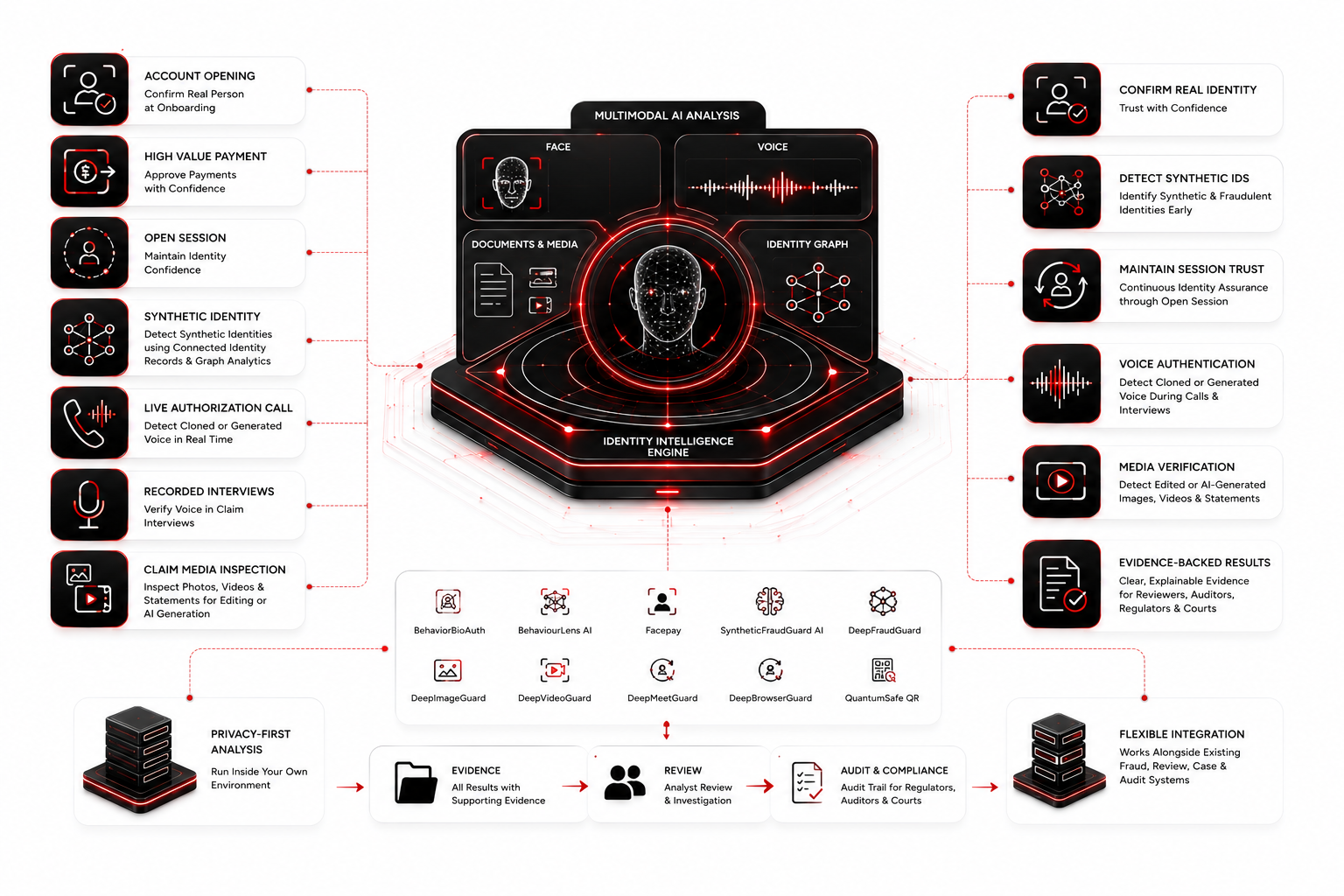
Confirm a real person at account opening

Before an account is opened, the applicant is confirmed as a live person rather than a photograph, a recording or someone standing in for them. The same check confirms a customer approving a high value payment, so the approval is tied to the person rather than to a code that can be moved to another device.

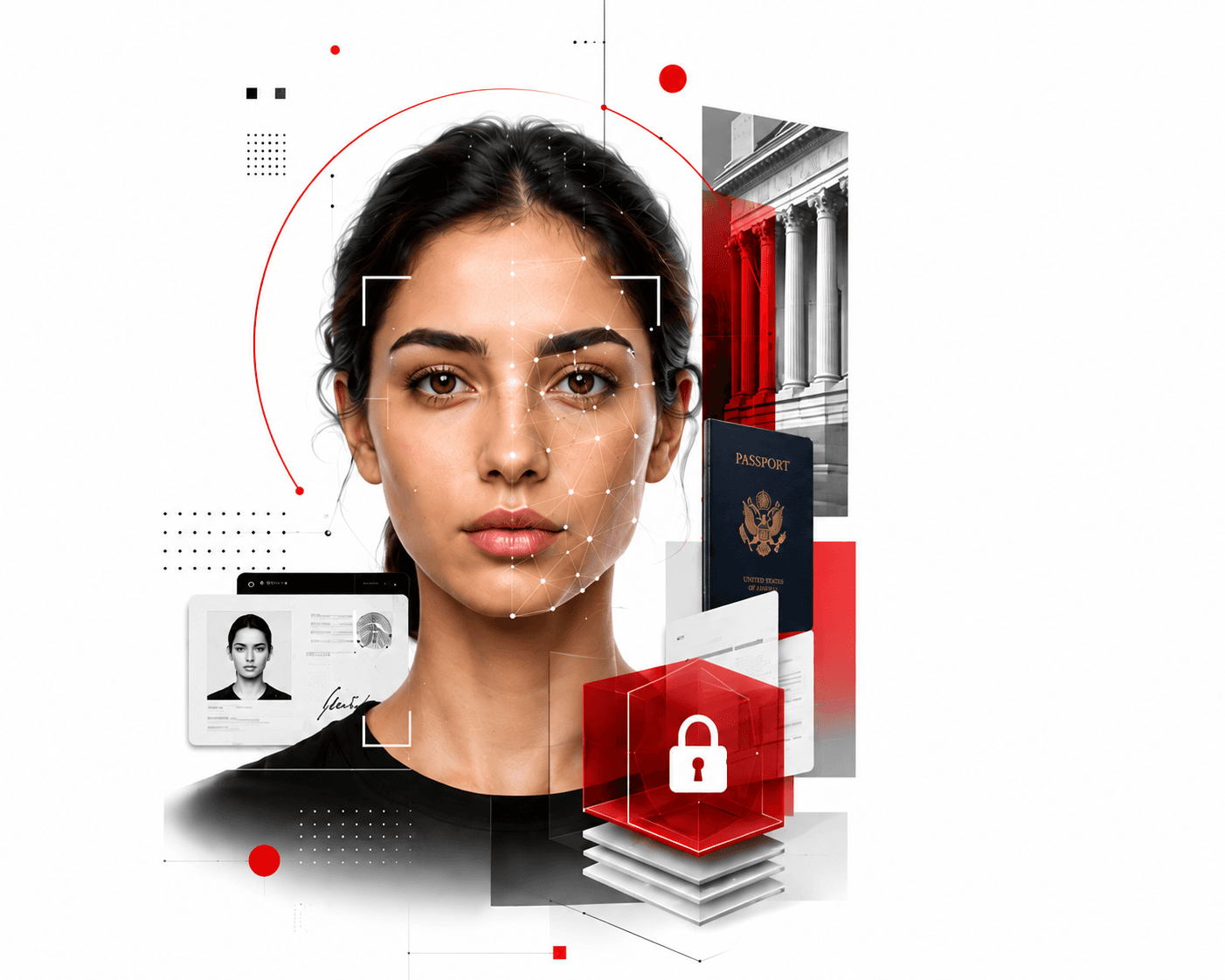
A face being read against a passport and an identity document, outside a bank

Find identities that were never real

Some applications are built from genuine details belonging to different people, which is why each detail checks out on its own. Records are read as a connected group instead, so a set of accounts that no unrelated customers would share becomes visible while those accounts can still be refused.

One person shown against several separate records, drawn as connected points

Keep checking after the customer has signed in

A session that was genuine at sign in can change hands part way through. Confidence in the customer is maintained quietly while the session is open, so a takeover during a transfer is caught while it is happening rather than found in a reconciliation weeks later.

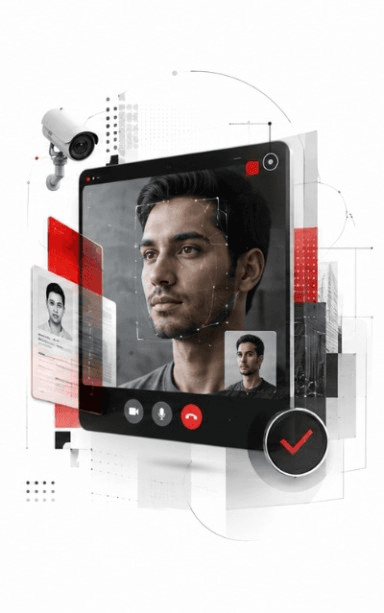
A video call with the participant’s face being tracked against their identity document

Show the evidence behind every result

No result arrives on its own. Each one carries the findings that led to it, so a reviewer can see what was noticed, act on it, and explain it later to an auditor, a regulator or a customer who has asked why.

A bank, a vault and a set of records held together as one connected structure

Catch a cloned voice before an instruction is acted on

Authorisation calls and recorded claim interviews are checked for speech that was generated or cloned rather than spoken. On a live call the result arrives while the conversation is still running, which is the only point at which it can change what happens next.

Check the photographs and video that arrive with a claim

Images, video and recorded statements submitted with a claim are checked for signs of editing or AI generation. Where a file is long, the result points to the parts that deserve a closer look rather than leaving one verdict across the whole thing.

Where it is used

What FaceOff runs in banking & insurance

Every entry names a product on this site and describes it the way its own page does.

  1. SyntheticFraudGuard AI

    identities checked at account opening

  2. BehaviorBioAuth

    the session checked while it is open

  3. DeepAudioGuard

    cloned voices caught on a call

  4. DeepFraudGuard

    fraud attempts scored before approval

  5. Identity Intelligence Engine

    connected identity records

Common questions

Banking & Insurance, answered

SyntheticFraudGuard AI reads identity records as a connected group rather than one application at a time. An identity assembled from details that belong to several real people passes every check applied to it alone, but the group of accounts it sits in does not look like a set of unrelated customers. Those applications are surfaced while the account can still be refused, and the connections behind the finding are shown so a reviewer can judge it instead of accepting a score on trust.

See it score a real video

Bring your own footage. We will run it through the Adaptive Cognito Engine and walk you through the findings.