Skip to content
FaceOff Technologies

Government & Public Safety

From the first recording to the courtroom

An investigation now runs on material that may have been produced by software: a voice on a call, a video from a phone, an account that looks like a person with a history. FaceOff checks voice, video and online identity and returns graded findings with the reasoning attached, so an investigator can act on them now and still explain them later

Overview

The recording used to be the fixed point

Verify identity on live camera networks, search recorded footage, and check whether a video, a voice or an online account is genuine.

Law enforcement investigation and evidence analysis

An investigation has always leaned on recordings. A voice on a call, footage from a camera, a photograph sent between two phones. Whatever else was disputed, the recording itself was usually the fixed point everything else got measured against.

That is no longer safe to assume. A voice can be copied from a short sample, a face can be placed onto somebody else's body, and an account with years of apparent history behind it can be built in an afternoon. The damage runs in both directions: a fabricated recording can send an enquiry in the wrong direction for months, and a genuine one can be brushed aside by a suspect simply claiming a machine made it.

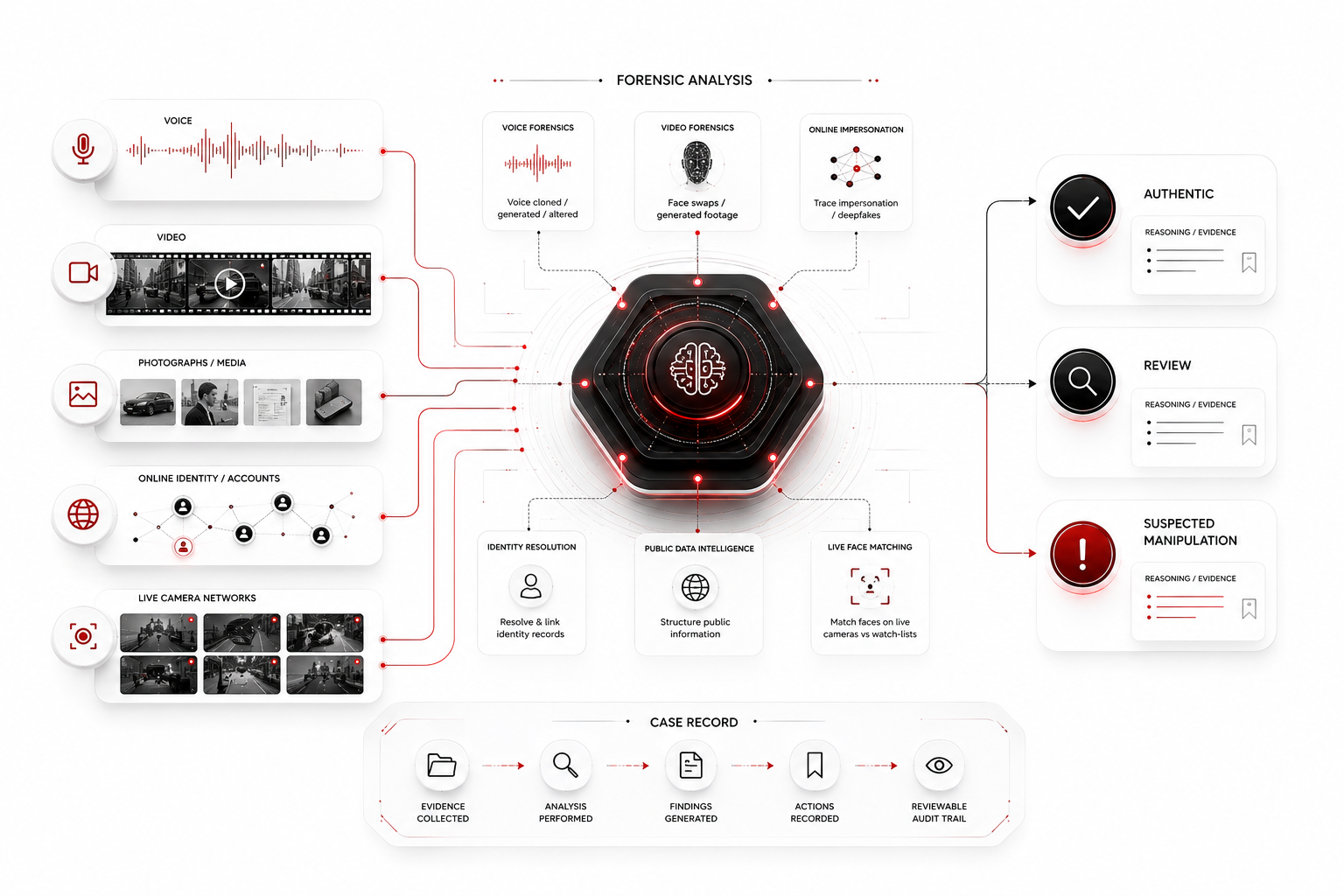
The checks below examine the material an investigation actually collects and return a graded finding with the reasoning behind it, showing what was noticed and where. That is what lets a line of enquiry be justified at the time and the work be reviewed later by a supervisor, an expert instructed by the defence, or a court.

What you deploy

Products for Law Enforcement

These are the products investigation teams deploy most often, following a case from the material that comes in, to the identities and accounts behind it, to the cameras that might place somebody somewhere.

BehaviourLens AI

Autonomous voice interviewer with trimodal audio, visual and linguistic forensics.

Explore

CrossCam PersonTrack

Live face recognition across your camera network, matched against your watch-lists.

Explore

DeepVideoGuard

Detection of AI generated Deepfake Videos

Explore

DeepFakeFinder

Find and verify suspected deepfakes of a person across online platforms.

Explore

Identity Intelligence Engine

Cross-platform identity resolution and linkage.

Explore

SocialIntel Analyzer

Social media and public data intelligence.

Explore

Key capabilities

What FaceOff checks in law enforcement

What this sector asks for most often. Each one runs at the moment a decision is being made, and each returns a result a reviewer can explain to somebody else.

Check whether a recorded voice was actually spoken

Recorded audio is examined for speech that was cloned or generated rather than spoken by a person, and the passages that raised concern are kept so an investigator can listen to them instead of taking a summary on trust.

Check video before a case is built on it

Video collected during an investigation is examined for face swaps and generated footage, and the finding points to the moments that need review. A long recording becomes a short list of passages worth an investigator's time rather than a day of playback.

Find where else a fake of a person appears

When somebody is impersonated, whether a suspect, a witness or an officer, the material rarely stays in one place. Suspected fakes of a named person are traced across online platforms and each match is checked against the real person, with the monitoring held as a case file rather than a folder of screenshots.

Turn scattered public information into a case view

Public information about the accounts and people involved is drawn into one structured view, including profiles that were built rather than grown and accounts that move together. An investigator starts from a picture of the case instead of assembling one by hand.

Draw together records that may be one person

Identity records held across different authorised sources can be resolved and linked, with the relationships laid out for an analyst to review. An identity assembled from pieces of several real people becomes visible as a group rather than passing as a set of unrelated individuals.

Match a face on a camera network, with an officer deciding

Faces on live cameras are matched against watch lists your own investigators build, and every match arrives graded for an officer to accept or reject. It runs on hardware you own inside your own network, and every action taken is recorded.

Where it is used

What FaceOff runs in law enforcement

Every entry names a product on this site and describes it the way its own page does.

  1. DeepAudioGuard

    recorded voice checked for cloning

  2. DeepVideoGuard

    video evidence checked for manipulation

  3. DeepFakeFinder

    fakes of a person traced online

  4. CrossCam PersonTrack

    faces matched on live camera networks

  5. SocialIntel Analyzer

    public information turned into a case view

Common questions

Law Enforcement, answered

A graded finding with the reasoning behind it, showing what was noticed and where in the material. It is written to be reviewed and challenged rather than accepted, because a conclusion an investigator cannot explain will not survive a supervisor, let alone a court.

See it score a real video

Bring your own footage. We will run it through the Adaptive Cognito Engine and walk you through the findings.