
Enterprise technical hiring
Run first-round screening on questions derived from the job description and the candidate's own résumé, with forensics that establish whose answers they are.
How the sector deploys itConducts the interview by itself, holding a spoken conversation with the candidate at a human pace while reading three forensic dimensions at once: how they sound, what their face and posture reveal, and what their words actually claim. All three are fused into one behavioural signature per turn, backed by a report you can defend
Read at the same time
Interface simulation: an illustration of the workflow, not a live analysis
BehaviourLens AI
Follow a single interview turn, end to end
What it is
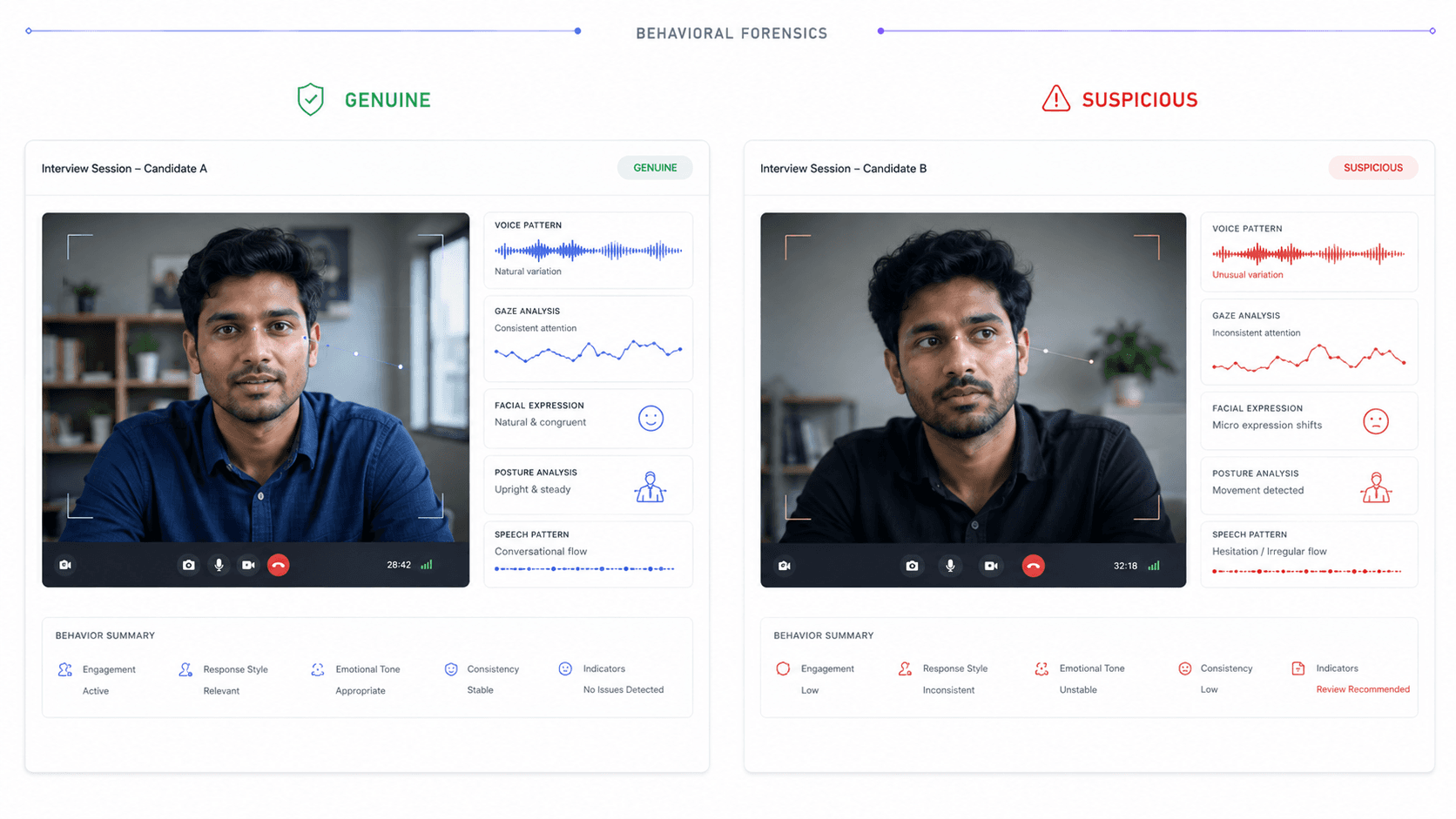
A video platform records the candidate and hands the whole review back to your team. A chat based interviewer reads the answers as text and scores the words. BehaviourLens AI does the interview: it asks, listens, decides what to ask next and replies out loud.
While the candidate answers it takes in three things at once: how they sound, what their face and posture show, and what the answer actually claims. The three are read together rather than one after another, which is what lets a confident delivery and an uncertain answer show up as the contradiction they are.
An interview is never only what somebody says. BehaviourLens AI reads the rest of it the same way every time: on every candidate, on every question, for the whole session.
Inside the record
The session as a whole, and any single answer opened up to what sat behind it.
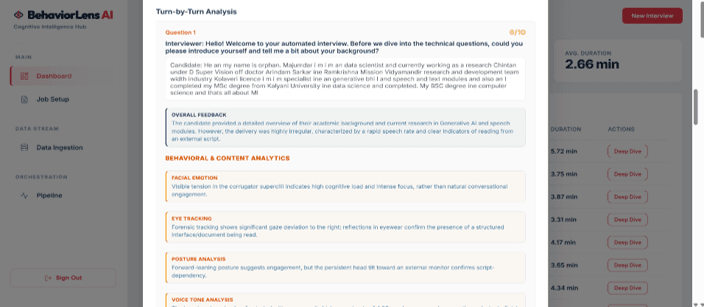
The interview as it happened: what was asked, what the candidate said, and the reading that followed, with the length of each answer alongside it. Any turn opens for a closer look.
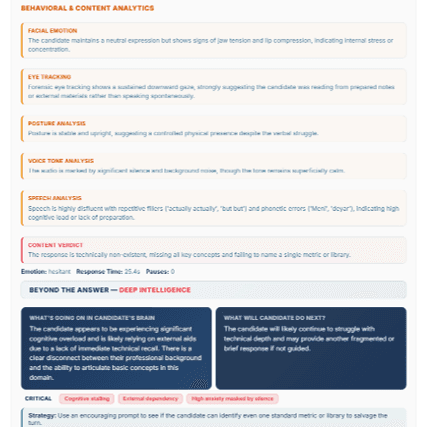
Expression, eye movement, posture, voice and wording considered together for a single answer, then a plain summary of what it suggests and what to ask next.
High-level architecture
The role, the résumé and any expected answers loaded up front
The conversation opens and the candidate begins answering
Voice, face and answer taken in together, as they speak
The assessment and the next move settled as the answer ends
The reply comes back in a natural, interruptible voice
The session written up as a score, a recommendation and its evidence
Interface simulation: an illustration of the workflow, not a live analysis
The role, the résumé and any expected answers loaded up front
The conversation opens and the candidate begins answering
Voice, face and answer taken in together, as they speak
The assessment and the next move settled as the answer ends
The reply comes back in a natural, interruptible voice
The session written up as a score, a recommendation and its evidence
Product exclusiveness
Trimodal forensic fusion into one signal
Interface simulation: an illustration of the workflow, not a live analysis
Market comparison
Real-time spoken conversation
Emotion detection
Micro-expression & gaze analysis
Adapts its questioning mid-interview
Questions grounded in the role
Remote proctoring
Psychometric profiling
Automated forensic report
Runs on your own infrastructure
The architecture
It runs on machines you control, and what survives an interview is the reading rather than the candidate's face.
What goes in
The candidate
Nothing to install, on a link that is encrypted the whole way
Where it runs
Your own servers, your private cloud, or a network with no internet at all
What is read
What is kept
Webcam frames are read as they arrive and are not saved. What survives the session is the reading (the result and the evidence behind it) rather than the images it was read from. The voice recording is locked while it is held, and deleted on a schedule you set.
What comes out
Use cases by sector
Run first-round screening on questions derived from the job description and the candidate's own résumé, with forensics that establish whose answers they are.
How the sector deploys itStandardised behavioural assessment for clearance evaluation, with a signed audit trail and a report that holds up under scrutiny.
How the sector deploys itScreen for regulated advisory roles, surfacing stress signals at the moment a scenario-based question turns adversarial.
How the sector deploys itAssess clinical knowledge depth alongside bedside manner, measuring communication warmth for telemedicine and frontline roles.
How the sector deploys itAssess thousands of graduates to the same depth regardless of the hour or the interviewer's fatigue, with a generated report for each.
How the sector deploys itEvaluate communication clarity, resilience under pressure and strategic thinking under sustained forensic probing.
Deployment strategy
01 · Deploy on your infrastructure
Interface simulation: an illustration of the workflow, not a live analysis
Data protection
Where it runs, what is kept, what it is ready for, and how a decision is checked after the fact.
A chatbot interviewer reads the words and replies from a script, with a wait between turns. BehaviourLens AI holds a spoken conversation and reads three things at once: how the candidate sounds, what their face and posture show, and what the answer actually claims. Because the three are read together as the candidate speaks, it can follow up, clarify or encourage at the pace of a real interview.
It settles the assessment, the read on the candidate and the next question together rather than one after another. Designs that take them in sequence leave a long silence between turns, and a silence changes how people behave: they fill it, or they tighten up. Keeping the cadence conversational is the condition the whole reading assumes.
In two ways. During the interview it watches for the signs that somebody is being helped and raises them only when it is confident, so a phone on the desk is not a flag and reading from one is. It also compares what is being said with how it is being said: an answer that is word perfect while everything else says the candidate is uncomfortable is a contradiction no single reading would catch, and the session is marked for someone on your team to review.
No. BehaviourLens AI is built to run entirely inside your own environment, including networks with no internet access at all. Everything it needs to hold the interview and produce the report is installed with it, which is why it is used for clearance and other sensitive hiring.
From the material you give it before the interview: the job description, the candidate's résumé and any answers you expect. Questions are built from what the role requires and what the candidate says they have done, and the next one is prepared while the current answer is still being given, which is what removes the pause other systems leave between turns.
Every answer is assessed against what the role actually asks for, and the session is read for consistency, for whether the candidate improved or tired as it went on, and for how steadily they handled pressure. Those come together as one score and a tiered recommendation (Strong Hire, Hire, Consider, Reject), and the report shows what sits behind each part of it.
Yes. After each answer it chooses what serves the interview best: move on when the answer was good, probe when it was thin, ask again when it was unclear, offer encouragement when the candidate is struggling, or close the session. There is a limit on how long it can stay with one topic, so nobody is questioned in circles.
The video is not kept. Camera images are read while the interview is running and are never saved, so what remains is the assessment and the evidence behind it. Audio is encrypted while it is held and deleted on the schedule you set, each customer's data is stored separately, and every session is recorded in a way that lets a decision be checked and attributed later.
The rest of the line
Where it runs
Each sector page covers the threat model, the controls, and the regulators that apply.
Book a walkthrough and bring a real job description and résumé. We will set up a live session around them and take you through the report it produces at the end.