Skip to content
FaceOff Technologies

Health & Education

Confirm the clinician. Protect the patient.

Care now reaches people through a screen, and a face on a consultation, a voice on a pharmacy call and a code on a medicine pack can all be produced by software. FaceOff confirms the person and the packaging at the moment care is given, and every result comes back with the reasoning behind it. Built to sit inside the Digital Personal Data Protection Act 2023, which treats patient information as sensitive personal data

Overview

Care arrives through a screen, and so does the fraud

Confirm that the clinician on a call is the registered clinician, and that credentials and packaging presented as genuine really are.

Healthcare security and data protection

A hospital, an insurer and a public health programme all rest on the same set of assumptions: that the clinician on the consultation is the registered clinician, that the person opening a patient record is the member of staff who signed in, and that the medicine inside the box is the medicine on the label. Each of those used to be settled by somebody being in the room.

Remote care removed the room. A consultation is now a video window, an authorisation is a voice on a phone, a qualification is a certificate attached to an email and a medicine pack is a printed code. All four can be produced convincingly enough that looking harder does not settle it, and the people asked to judge them are clinicians, pharmacists and administrators rather than investigators.

FaceOff answers the question while the answer still changes something, which is before a consultation is trusted, before a record is opened, before a prescription is dispensed and before a pack reaches a patient. Every result carries the findings behind it, written for the person making the decision and in a form that holds up later in an audit, a complaint or a court.
What you deploy

Products for Healthcare

These are the products hospitals, telemedicine platforms and health programmes deploy most often, in the order they usually land: confirming the clinician and the staff member, checking the consultation and the media that arrives with a case, and giving credentials and packaging something that can actually be verified.

BehaviorBioAuth (Onboarding)

Behavioral biometric identity verification.

Explore

BehaviourLens AI

Autonomous voice interviewer with trimodal audio, visual and linguistic forensics.

Explore

DeepMeetGuard

Confirm the person on a video call is real, while the call is happening.

Explore

DeepVideoGuard

Detection of AI generated Deepfake Videos

Explore

DeepImageGuard

Detection of AI generated Deepfake Images

Explore

QuantumSafe QR

Post-quantum QR for secure credentials and access.

Explore

PharmaQR

Verifiable QR authentication for pharmaceutical packaging.

Explore

Key capabilities

What FaceOff checks in healthcare

What this sector asks for most often. Each one runs at the moment a decision is being made, and each returns a result a reviewer can explain to somebody else.

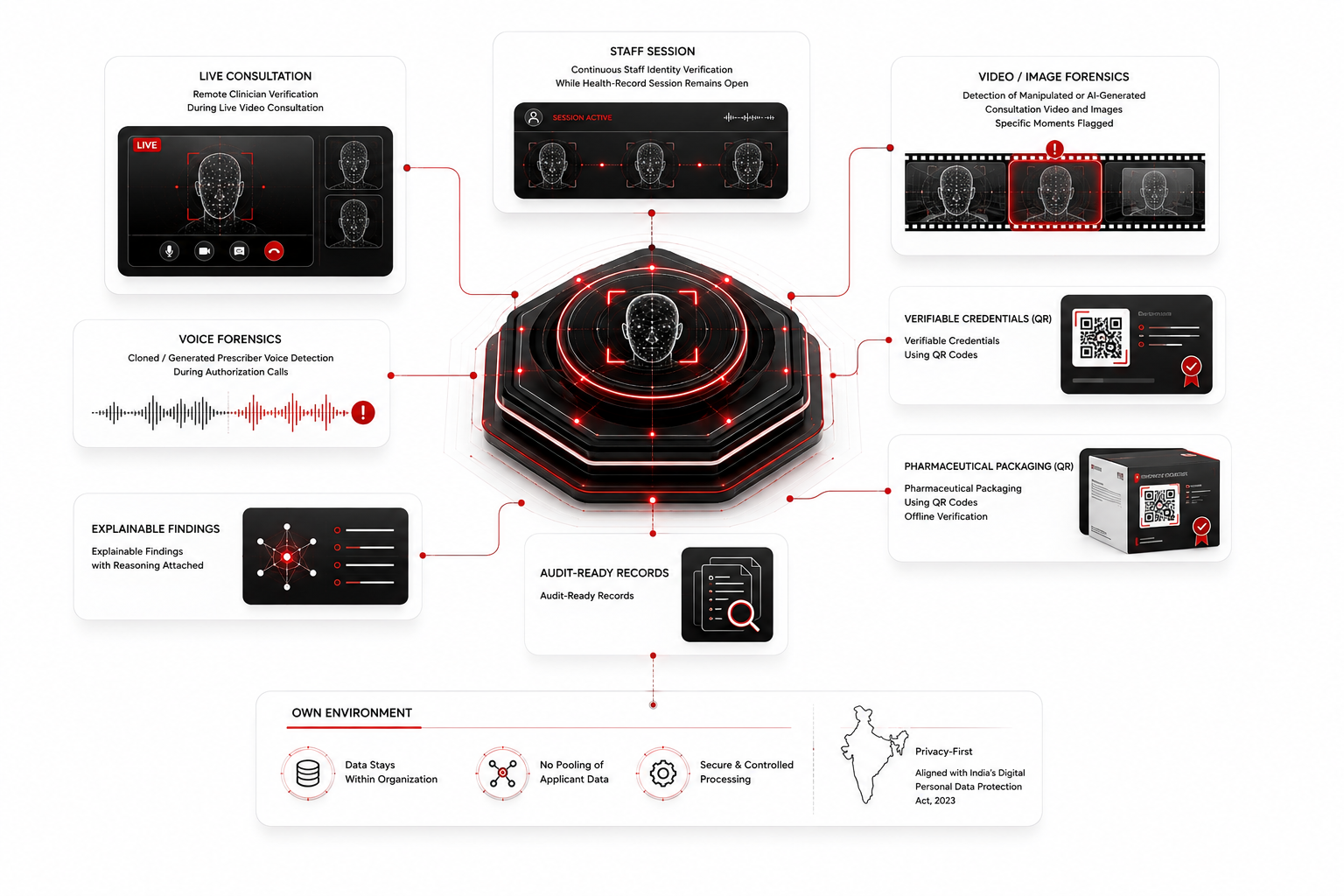
Confirm the clinician on a remote consultation

Before a consultation is trusted, the person on the call is confirmed as a real participant rather than a recording, a substituted face or one that was generated. The answer arrives while the consultation is still running, which is the only point at which it can change what happens to the patient.

Keep patient records in the right hands

A login is checked once, but a clinical shift lasts all day. Confidence in the member of staff is held quietly for as long as the session is open, so a shared or handed over login is surfaced rather than inherited from a check that passed hours earlier, and no store of biometric templates is built up along the way.

Check the video and images attached to a case

Consultation recordings, and the images and video submitted with a claim, a case file or a second opinion, are checked for signs of editing or AI generation. Where a recording is long, the finding points to the parts that deserve a closer look instead of leaving one verdict across the whole thing.

Catch a cloned voice before medicine is dispensed

Authorisation calls are checked for speech that was generated or cloned rather than spoken, and the result arrives while the call is still in progress. That is the point at which a pharmacist can decline an instruction that was never actually given.

Give a credential and a pack something that can be checked

Qualifications and medicine packaging carry a code confirming the item is genuine and has not been altered, and a copied code does not become a trusted one. The check works without an internet connection, which matters in the places where care is actually delivered.

Leave a record the hospital can stand behind

Every completed check leaves a finding with its reasoning attached, so a decision about a clinician, a record or a pack can be explained months later to a regulator, an insurer, an internal review or a family who has asked what happened.

Where it is used

What FaceOff runs in healthcare

Every entry names a product on this site and describes it the way its own page does.

  1. BehaviorBioAuth

    access to health records checked continuously

  2. DeepVideoGuard

    consultation video checked for manipulation

  3. DeepAudioGuard

    cloned prescriber voices caught on a call

  4. DeepMeetGuard

    the person on a live consultation confirmed

  5. PharmaQR

    medicine packaging that can be verified

Common questions

Healthcare, answered

DeepMeetGuard confirms that the person on a live video call is a real participant while the call is happening, rather than a recording or a generated face. It covers the meeting platforms clinics already use, including Zoom, Teams and Meet, and a warning arrives before a decision is made rather than after the consultation has ended.

See it score a real video

Bring your own footage. We will run it through the Adaptive Cognito Engine and walk you through the findings.