Manufacturers
Protect individual products with verifiable identities, control authorised production quantities, and respond quickly when a batch is compromised or withdrawn.
Verify whether a medicine pack is genuine before it is used. Each protected pack carries a unique PharmaQR that connects the physical product with verified information from the authorised manufacturer, and a simple scan returns a clear authenticity result with the registered product details
Checks before a result
Interface simulation: an illustration of the workflow, not a live analysis
What it is
Counterfeit medicines can closely imitate genuine packaging. Brand colours, printed labels, batch information and ordinary QR codes can all be copied, making visual inspection alone unreliable.
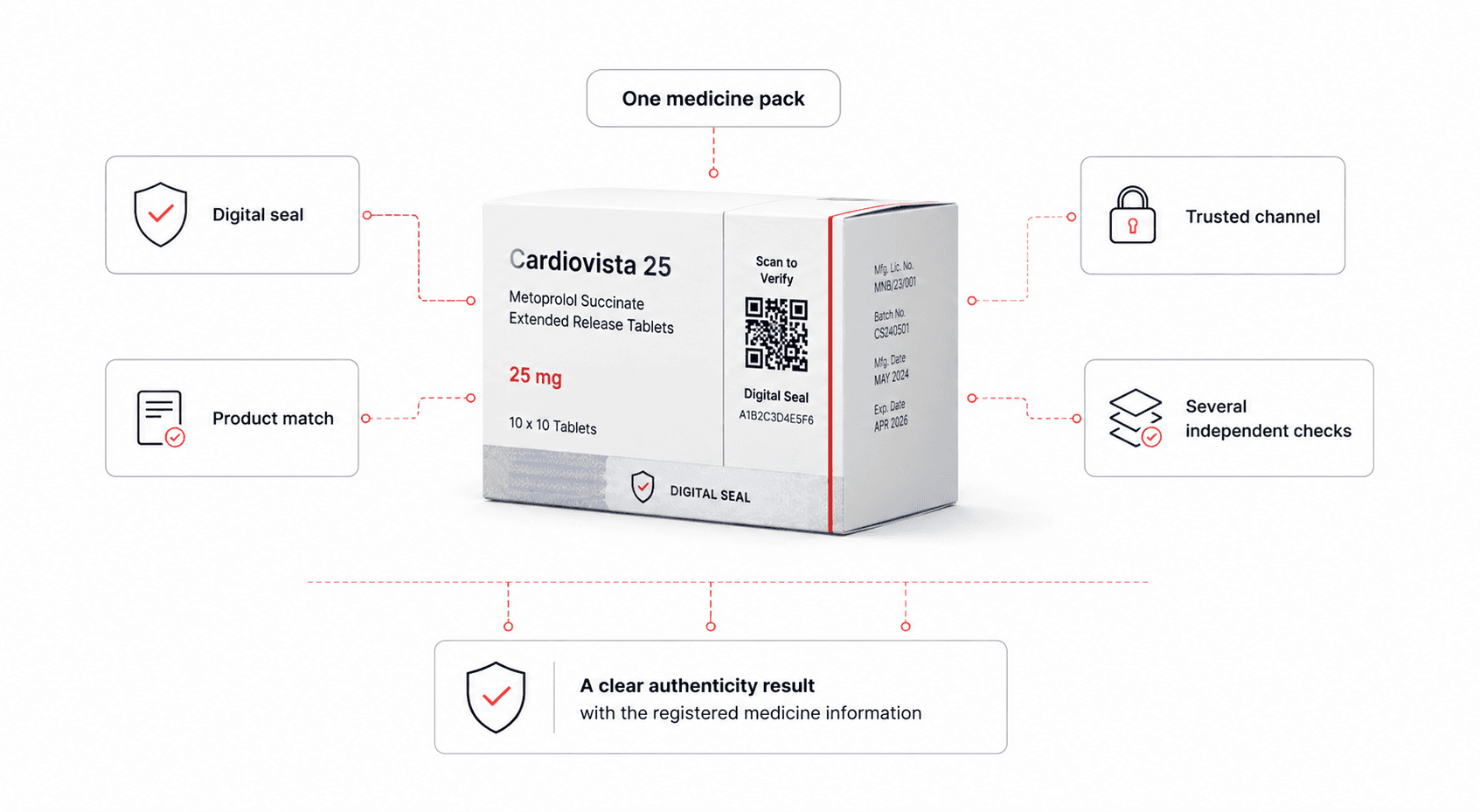
PharmaQR adds a verifiable digital identity to individual medicine packs. When the QR is scanned, the system checks whether the code belongs to an authorised manufacturer, whether the registered product information matches and whether the verification result can be trusted. Consumers receive a simple result instead of having to understand the technology behind it.
Sensitive manufacturing information stays under appropriate control rather than being unnecessarily exposed through a public verification service.
Future ready protection
Designed to protect pharmaceutical product identity over the long term
Fast verification
Designed to provide an authenticity result within seconds
Production ready
Suitable for generating protected codes at pharmaceutical production scale
Auditable by design
Important manufacturer and product actions traced through controlled records
How it works
No account and no personal details required
The QR carries a valid identity issued for an authorised product
Registered product information is checked against the code
The request is confirmed to come through a trusted channel
The result is protected before it is delivered to the user
A clear result with the registered medicine information
Interface simulation: an illustration of the workflow, not a live analysis
No account and no personal details required
The QR carries a valid identity issued for an authorised product
Registered product information is checked against the code
The request is confirmed to come through a trusted channel
The result is protected before it is delivered to the user
A clear result with the registered medicine information
What sets it apart
Future ready digital protection
Interface simulation: an illustration of the workflow, not a live analysis
How it compares
Consumer authenticity check
Protection designed for future security needs
Manufacturer controlled operational data
Protected verification result
Protected manufacturer credentials
Supply chain visibility
Consumer account required
The architecture
Product authorisation, medicine identity and consumer verification, separated into controlled stages
At issuance
Protected identities created for authorised medicine units
On the pack
A patient, pharmacist, distributor or inspector scans the QR
Public verification is separated from sensitive day to day manufacturing operations. Consumers can check a medicine without creating an identity profile, while manufacturers retain control over their operational information.
All four have to pass. Where a check cannot be completed, the user is asked to scan again rather than shown an unsupported authenticity decision.
At the point of scan
A clear authenticity result with the registered medicine information
Evidence and trust
High volume readiness
Supports the large number of unique product identities pharmaceutical manufacturing requires
Fast scan response
Results returned quickly enough for practical use at pharmacies, distribution points and consumer locations
Tamper detection
Manipulated, invalid, mismatched or withdrawn identities fail authenticity checks rather than passing as genuine
Genuine product reliability
Correctly registered genuine products are recognised without turning ordinary repeated scans into suspicious behaviour
Controlled onboarding
Manufacturer and product registration steps are validated before protected identities can be issued
Security review
Structured internal review, with deeper technical assessment available to authorised partners, auditors and regulators
PharmaQR is designed to complement physical packaging protection rather than suggesting that one printed QR alone can solve every form of pharmaceutical counterfeiting.
Use cases by sector
Protect individual products with verifiable identities, control authorised production quantities, and respond quickly when a batch is compromised or withdrawn.
Keep product identity, production responsibility and permitted quantities clearly separated across outsourced pharmaceutical production.
Visibility when authorised products and batches are registered under protected brands, connecting brand owner, manufacturer and products entering the supply chain.
Verify medicines when consignments arrive rather than discovering authenticity concerns further down the chain, without changing normal handling procedures.
How the sector deploys itCheck a medicine before dispensing or use, comparing the details shown on the phone with the pack. No consumer account is required.
How the sector deploys itUse product verification and traceable records as an additional source of evidence during inspections or investigations.
How the sector deploys itDeployment strategy
01 · Establish the trust environment
Interface simulation: an illustration of the workflow, not a live analysis
Long term protection, data control, trusted credentials and accountability.
It checks whether the scanned code belongs to an authorised manufacturer and registered pharmaceutical product, and validates the integrity of the product information and the verification process before displaying the result. The user does not need to understand or interact with the technology behind it.
Medicines can remain in manufacturing, distribution and storage for long periods, so the digital protection attached to a product is designed to stay appropriate for long term use rather than relying only on older security approaches.
The central verification layer holds the information required to establish trusted identities and authenticate products. Sensitive day to day operational information can remain under the manufacturer's control.
No. A consumer can scan a PharmaQR without creating an account or submitting their name, phone number or email address. The purpose of the scan is to authenticate the medicine, not identify the person holding it.
The authenticity result and the registered medicine information: product name, strength, composition, pack information, batch details, manufacturing information and expiry. The information on screen should be compared with the physical pack.
An incomplete scan is not treated as evidence of a counterfeit. Poor lighting, a damaged QR, camera problems or limited connectivity can prevent a complete check, so the user is asked to scan again rather than shown an unsupported decision.
Yes. PharmaQR is designed for verification throughout the supply chain: manufacturers, distributors, wholesalers, pharmacists, inspectors and consumers can all check protected products.
Yes. A medicine may legitimately be checked by several people as it moves from manufacturing through distribution and pharmacy to the patient. Repeated verification does not turn a genuine product into a counterfeit, though verification patterns can still help manufacturers identify unusual activity.
An authorised manufacturer can withdraw trust from the affected batch so that future verification reflects its changed status, without unnecessarily disrupting unrelated batches.
A randomly created QR does not become a trusted PharmaQR because it looks similar. A valid product identity must originate from an authorised manufacturer and correspond to registered pharmaceutical information.
Packaging can be copied, which is why PharmaQR should be viewed as part of a broader anti counterfeiting strategy. It identifies invalid identities and surfaces suspicious verification patterns, while physical packaging protections strengthen the defence against sophisticated copying.
No. It is an additional product authentication and supply chain trust layer. It does not replace national or state drug regulators, licensing systems, mandatory pharmaceutical labelling or other regulatory requirements.
It works alongside existing manufacturing, packaging, distribution and enterprise processes, supporting product registration, batch management, QR generation, verification, reconciliation and authorised system communication without replacing your technology environment. Detailed integration and security documentation is shared only with authorised technical teams during implementation.
The rest of the line
Where it runs
Each sector page covers the threat model, the controls, and the regulators that apply.
See how PharmaQR helps manufacturers protect pharmaceutical products and enables consumers, pharmacists and distributors to verify medicines through a simple scan.