
Government & national ID
Issue digital citizen credentials that authorized organizations can verify as genuine.
How the sector deploys itIssues and verifies trusted digital identity credentials through secure QR codes. Altered, copied or counterfeit credentials are detected before their information is accepted, and verification works in connected as well as low-connectivity environments
Checked before trust
Interface simulation: an illustration of the workflow, not a live analysis
QuantumSafeQR
Follow a credential from print to proof
What it is
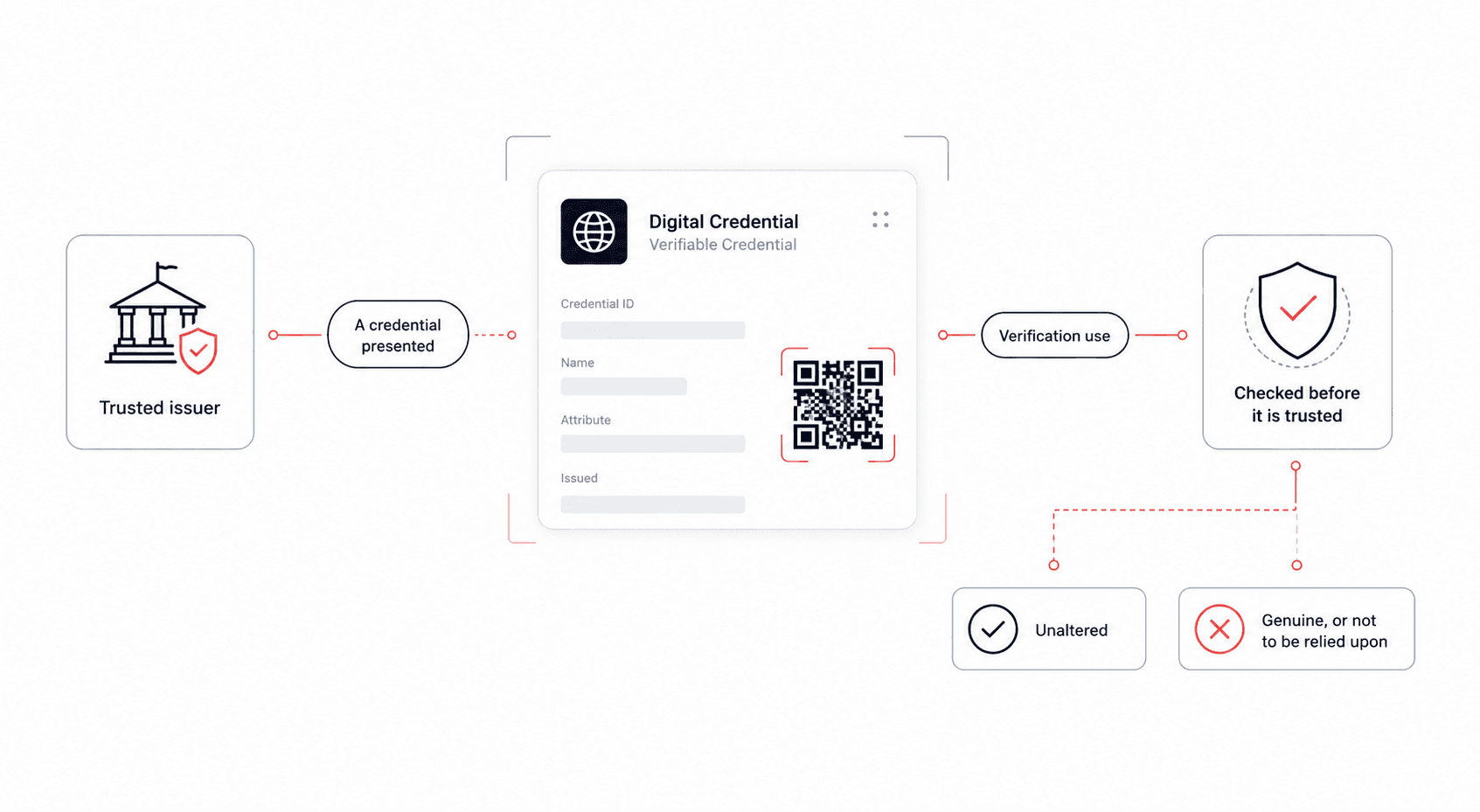
A QR code is easy to share, but an identity credential needs stronger protection. QuantumSafeQR turns QR based credentials into verifiable digital records, so an organization can tell whether a credential came from a trusted issuer and whether it has been altered.
Before information from a presented credential is trusted, its authenticity is checked against the issuing authority, so suspicious or modified credentials are identified before they become part of an identity decision.
Verification supports both connected and offline environments, and the security architecture is designed for long term resilience as cryptographic requirements change.
Future ready
Security foundations designed to evolve with changing cryptographic requirements
Verify before trust
Authenticity is confirmed before a credential's information is relied upon
Online & offline
Verification supports connected environments and places where connectivity is limited
Controlled access
Sensitive security operations are protected by enterprise grade controls
How it works
An authorized organization issues the credential
Protections applied before it reaches the holder
Held in an approved wallet, portal or app
Authenticity checked, online or offline
Issuance and verification activity recorded
Interface simulation: an illustration of the workflow, not a live analysis
An authorized organization issues the credential
Protections applied before it reaches the holder
Held in an approved wallet, portal or app
Authenticity checked, online or offline
Issuance and verification activity recorded
What sets it apart
Future ready credential protection
Interface simulation: an illustration of the workflow, not a live analysis
How it compares
A standard QR code carries information, but never proves it is authentic or issued by anyone you trust
Trusted issuer verification
Tamper detection
Protected credential information
Offline verification
Long term security readiness
Suspicious usage monitoring
Privacy lifecycle controls
Centralized audit history
The architecture
One boundary, and nothing in the credential is relied upon until its authenticity checks out
At issuance
Protections applied before it is released
With the citizen
Held in an approved web or mobile app
Authenticity is checked against the issuing authority before the information is accepted. A modified or counterfeit credential is rejected up front.
At the point of check
Checked wherever the credential is presented
Use cases by sector
Issue digital citizen credentials that authorized organizations can verify as genuine.
How the sector deploys itVerify patient identity and healthcare eligibility, including where connectivity is unreliable.
How the sector deploys itIssue verifiable diplomas and certificates employers and institutions can check with confidence.
How the sector deploys itCheck travel credentials at the point of entry, connected or offline.
How the sector deploys itUse verified digital identity in onboarding and identity sensitive financial journeys.
How the sector deploys itConfirm eligibility for benefits and services, and surface unusual patterns for review.
Deployment strategy
01 · Establish the issuance environment
Interface simulation: an illustration of the workflow, not a live analysis
Trust has to extend beyond the QR code: controlled issuance, protected credential security, clear governance and privacy that lasts the life of the credential.
Copying the appearance of a QR code does not make the copy trustworthy. QuantumSafeQR adds verification protections that determine whether a presented credential is genuine and has remained unchanged: stronger assurance than relying on the QR image alone.
It means designing digital security with long term cryptographic resilience in mind, so credential infrastructure is prepared for evolving security requirements, including threats that may emerge as advanced and quantum computing technologies develop. The specific security architecture can be discussed during technical evaluation.
Not always. Verification supports both connected and approved offline scenarios, which suits checkpoints, healthcare services, field operations, campuses and other places where connectivity is inconsistent. The exact offline capabilities depend on the deployment.
Critical security functions are protected within controlled enterprise environments and separated from ordinary user access. Access controls, protected security services, monitoring and operational governance reduce unauthorized access. Detailed implementation information is shared during security and architecture reviews.
Unusual credential usage is highlighted for investigation according to organizational policy. Rather than relying only on whether a credential appears valid, the platform gives authorized teams additional operational context.
The platform supports privacy operations such as data access, portability, retention management, deletion and anonymisation where required by the deployment and applicable regulations. Organizations configure these processes according to their legal and policy obligations.
Yes. It is designed for high assurance credential environments (national identity, citizen services, permits, benefits, healthcare identities and educational credentials) so universities, professional bodies and certification authorities can also let employers verify that a qualification was issued by an authorized institution. The final architecture is configured to the issuing authority's requirements.
No identity technology should be positioned as making fraud impossible. QuantumSafeQR is designed to make tampering, unauthorized modification, counterfeit presentation and suspicious usage easier to identify, with stronger controls than a conventional QR based credential.
The rest of the line
Where it runs
Each sector page covers the threat model, the controls, and the regulators that apply.
Have a solutions engineer walk your team through issuance, verification in connected and offline environments, and the audit history it leaves behind.