
Fraud investigation
Examine whether apparently separate names, accounts, profiles or associated organisations may belong to the same wider identity or network, before moving into deeper fraud analysis.
See when profiles, aliases, records and digital identifiers found across different authorised sources may relate to the same person, account or organisation, with the evidence behind every connection kept in view and the final judgement left to the analyst
What it starts from
Interface simulation: an illustration of the workflow, not a live analysis
What it is
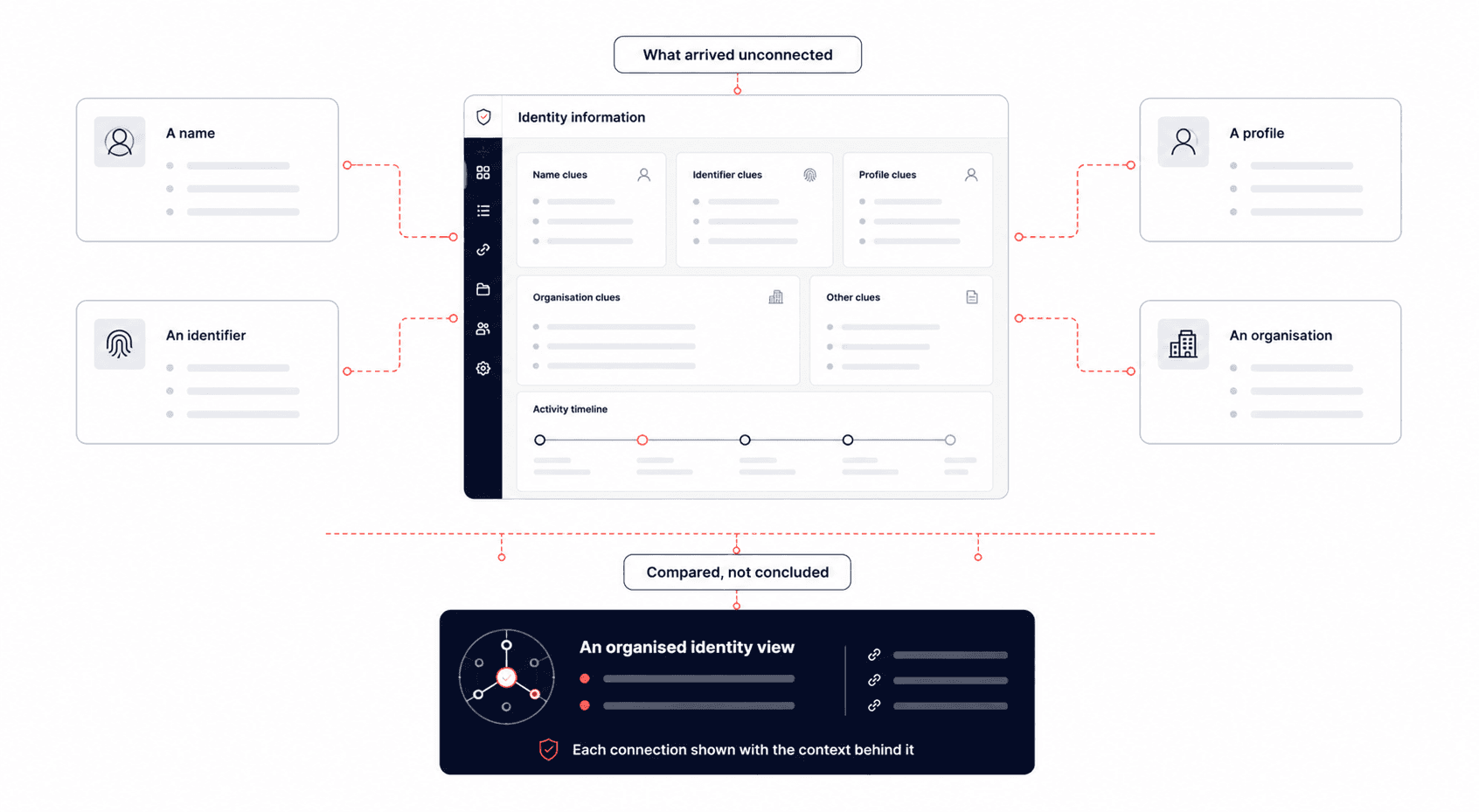
Digital identities are fragmented. The same person or organisation may appear differently across social platforms, public sources, business records and other authorised information sources. Names vary, usernames change, contact information turns up in different places, and organisations connect through several people or digital identities. Looking at each clue separately hides the bigger picture.
Identity Intelligence Engine brings those fragments together. It examines the available identity information, highlights possible relationships and presents connected context for analyst review, rather than asking investigators to trust a single automated match.
What appears connected, what evidence supports the connection, and what should be examined further.
Cross source
Relevant identity information from different authorised sources brought into one consistent view
Identity linkage
Possible connections surfaced between identities that would otherwise appear unrelated
Relationship context
How people, profiles, organisations and associated information may connect
Analyst controlled
Automated intelligence supports the investigation rather than replacing professional judgement
How it works
A name, profile, digital identifier or organisation
Relevant records organised from connected, permitted sources
Similarities, differences and context examined
Aliases, profiles and records brought into one identity view
How identified people, organisations and profiles may relate
Each connection shown with the context behind it
An organised workspace for review and authorised reporting
Interface simulation: an illustration of the workflow, not a live analysis
A name, profile, digital identifier or organisation
Relevant records organised from connected, permitted sources
Similarities, differences and context examined
Aliases, profiles and records brought into one identity view
How identified people, organisations and profiles may relate
Each connection shown with the context behind it
An organised workspace for review and authorised reporting
What sets it apart
Connect identities across sources
Interface simulation: an illustration of the workflow, not a live analysis
How it compares
Find identity information
Bring identity clues together
Cross source identity linkage
Relationship exploration
Supporting context for matches
Unified identity view
Human review
Structured investigation support
The architecture
Deliberately simple: what happens to identity information, without the correlation methods behind it
Authorised information sources
Public, organisational or connected sources the team is authorised to use
Identity discovery
Potentially relevant records, profiles and identifiers gathered in one place
Identity correlation
Available information examined for meaningful relationships, not treated as proof
Relationship context
Analyst review
Potential identity relationships examined by an authorised analyst before they are relied on
Access, investigation scope and data handling stay aligned with organisational governance requirements.
Evidence and trust
Supporting context
Potential connections arrive with the information that explains why the relationship was surfaced
Uncertainty awareness
Incomplete or conflicting information stays open for investigation instead of becoming silent certainty
Human validation
Analysts review significant identity relationships before they are used for consequential decisions
Traceable investigation
Important investigation activity is kept as a structured record of how an identity view developed
Sensitive identity information can be restricted according to organisational roles and responsibilities, and the platform should be operated under applicable privacy, data protection, investigation and organisational policies.
Use cases by sector
Examine whether apparently separate names, accounts, profiles or associated organisations may belong to the same wider identity or network, before moving into deeper fraud analysis.
Identity context across authorised sources when reviewing suspicious applications, connected parties or unusual account activity, complementing established KYC, AML and fraud controls rather than replacing them.
How the sector deploys itOrganise incomplete clues: a name in one case, a social profile in another, an organisation in a third, into a more connected investigation view.
How the sector deploys itStructure scattered information in authorised cases involving impersonation, misconduct, conflicts of interest or suspicious external relationships.
How the sector deploys itInvestigate possible connections between profiles and digital identities that appear unrelated when viewed individually, and understand coordinated or repeated activity.
How the sector deploys itEstablish whether records found across different sources refer to the same underlying person or organisation, while preserving the need for human verification.
A focused identity resolution layer for open source work that produces large numbers of disconnected results.
Deployment strategy
01 · Define the investigation scope
Interface simulation: an illustration of the workflow, not a live analysis
What it has to get right
Four things identity intelligence has to get right.
A cross platform identity resolution and linkage solution that helps authorised investigation teams connect fragmented identity information, so analysts can see whether records found in different places may relate to the same person, profile or organisation.
Determining whether different pieces of information may refer to the same underlying identity. Where an investigator finds several records or profiles that look related but carry different information, the platform organises and compares those signals for review.
Not in the traditional sense. A people search focuses on finding records; this focuses on understanding the relationships between identity information already available to an authorised investigation.
Yes. Cross platform identity linkage is a core purpose. Where suitable and authorised information is available, records appearing across different sources can be examined for connected identities.
No. A surfaced relationship is investigation intelligence that requires context and review. Similar information does not prove that two records belong to the same individual.
No. It identifies and organises possible relationships, but significant conclusions should be reviewed by an authorised person.
It should be configured around information the organisation is lawfully authorised to access. It is not a mechanism for bypassing privacy controls or obtaining restricted information.
SocialIntel Analyzer investigates publicly visible social media activity across supported platforms. Identity Intelligence Engine focuses on identity resolution and cross source linkage. They are complementary within a broader OSINT environment.
This resolves identities and their relationships; AML Intelligence is for financial crime and transaction pattern analysis. Keeping them separate keeps each purpose clear while identity context can support authorised downstream investigations.
Identity linkage gives useful context where investigators are examining fragmented or inconsistent identity information. Specialised synthetic identity fraud detection should still be treated separately: not every identity mismatch indicates fraud.
No. It provides identity correlation and investigation context. Formal verification, KYC, regulatory screening and authentication should continue to use the organisation's dedicated processes and controls.
Yes. Identity investigations involve sensitive information, so controlled organisational deployment is part of the design. Specific arrangements follow the organisation's security, privacy and operational requirements.
The rest of the line
Where it runs
Each sector page covers the threat model, the controls, and the regulators that apply.
Have a solutions engineer walk your team through an investigation, from a single identity clue to a connected identity view your analysts can review.