Law enforcement and investigation
Bring publicly available social media information into a structured case view: relationships, conversations, relevant accounts and findings preserved for further authorised investigation.
How the sector deploys itUnderstand publicly visible activity across Facebook, Instagram, LinkedIn and X from one investigation environment: connected people, conversations, relationships and evidence, with investigation data kept inside infrastructure your organisation controls
Where it looks
Interface simulation: an illustration of the workflow, not a live analysis
One module per platform, the same local loop on every one
The profile's own history is read first — the roles, the dates and the verification markers held against them — and the run ends on the connection graph, with each person on it carrying what the analysis found for them.
Beside the follower and engagement figures, the profile's media is examined image by image: file metadata, error-level analysis and a synthetic-authenticity reading, which is what separates a picture that was generated or altered from one that was not.
X (Twitter)
A thread is drawn as the network that carried it, and the accounts amplifying it are marked out: automated behaviour on one side, and a timeline showing mass account creation immediately before the conversation spiked on the other.
A post and its comment thread lead into ownership verification for the group behind it, cross-platform account links for the people in it, and an authenticity score against each account, drawn across the whole network.
What it is
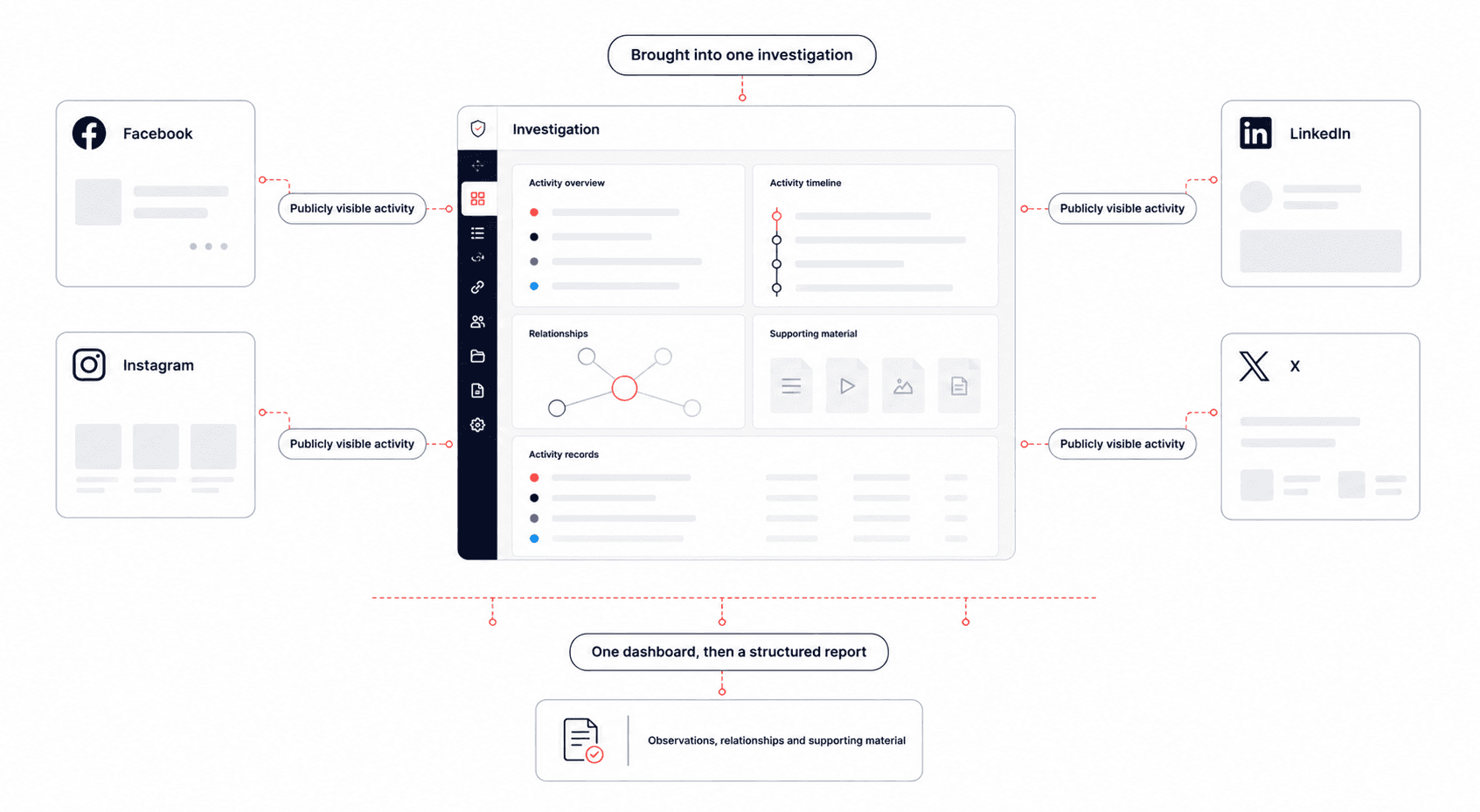
Online investigations rarely stay on one social network. A person may appear on Facebook, communicate through X, keep professional information on LinkedIn and share activity through Instagram, and reviewing each platform separately leaves investigators with fragmented information and missed connections.
SocialIntel Analyzer brings those public signals into one investigation experience. Dedicated capabilities for Facebook, Instagram, LinkedIn and X let analysts examine each platform in the context in which people actually use it, while a common intelligence layer brings the findings together.
Who is involved, what is being discussed, how people connect and what deserves closer attention.
4 platforms
Facebook, Instagram, LinkedIn and X, each investigated through a dedicated capability
Connected
Profiles, activity, conversations and relationships brought into one understandable view
Private
Investigation data and analysis stay within infrastructure your organisation controls
Report ready
Findings become structured reports that can be reviewed, shared and preserved
How it works
Facebook, Instagram, LinkedIn or X
The profile, account, conversation or topic in scope
Publicly visible activity organised in one place
Themes, tone, recurring subjects, text and images
Profiles and activity seen as connected, not isolated
Findings organised by relevance to the investigation
One dashboard, then a structured report or export
Interface simulation: an illustration of the workflow, not a live analysis
Facebook, Instagram, LinkedIn or X
The profile, account, conversation or topic in scope
Publicly visible activity organised in one place
Themes, tone, recurring subjects, text and images
Profiles and activity seen as connected, not isolated
Findings organised by relevance to the investigation
One dashboard, then a structured report or export
What sets it apart
Your investigation stays under your control
Interface simulation: an illustration of the workflow, not a live analysis
How it compares
Some tools concentrate on collecting information; others research broadly but shallowly. This one is designed around the investigation that happens after information is found.
Facebook, Instagram, LinkedIn and X coverage
Analysis beyond collection
Relationship and network exploration
Visual content intelligence
Investigation prioritisation
Organisation controlled processing
Structured investigation reporting
Deploy individual platform capabilities
The architecture
Unified intelligence layer
Analysis runs inside infrastructure your organisation controls.
Evidence and trust
Source context
Findings stay connected to the social activity they were identified from
Relationship visibility
Connections can be explored visually, showing why a profile or activity appears relevant
Analyst oversight
Prioritisation supports human review rather than declaring anyone suspicious or responsible
Consistent reporting
Findings follow a repeatable report structure instead of collected screenshots and notes
Organisations apply their existing access, security and data retention policies to investigation material, and a common analysis and reporting approach keeps a case coherent when relevant activity moves from one social network to another.
Use cases by sector
Bring publicly available social media information into a structured case view: relationships, conversations, relevant accounts and findings preserved for further authorised investigation.
How the sector deploys itBring together public signals of impersonation, scams, coordinated activity or exposed information, and understand how accounts, content and relationships connect.
Review public digital activity relating to fraud, impersonation or misconduct while investigation material stays under organisational control.
How the sector deploys itInvestigate fake profiles, misleading accounts and recurring activity to build a clearer picture of potential impersonation or coordinated brand abuse.
How the sector deploys itPlace structured public social information, relationship views and evidence-ready reporting alongside other authorised evidence sources.
Organisation controlled processing and structured analyst review for authorised intelligence work involving sensitive case material.
Deployment strategy
01 · Understand the requirement
Interface simulation: an illustration of the workflow, not a live analysis
What it has to get right
Four things social media intelligence has to get right.
Facebook, Instagram, LinkedIn and X. Each has dedicated investigation capabilities, while findings are reviewed through one consistent intelligence workflow.
No. Collection is one part of the workflow. The platform is built around understanding content, exploring relationships, reviewing visual information, prioritising findings and producing investigation reports.
No. It is intended for information that is publicly visible or otherwise legitimately available to an authorised user, and is not designed to bypass privacy settings or access restrictions.
No. Analysis is designed to run within infrastructure the organisation controls, so sensitive information, access controls and retention policies stay with the organisation.
Yes. Start with the capability that matches the immediate requirement and add other supported networks later.
Where supported and appropriate. It can help review recurring visual subjects and text appearing within public images, reducing repetitive manual review.
No. It can prioritise information and highlight patterns worth attention, but those outputs are not declarations of guilt, intent or wrongdoing. Investigators interpret findings in context.
Structured investigation outputs for analyst review, authorised sharing and further analysis: readable reports as well as structured data for downstream investigation workflows.
No. Resources are chosen according to investigation volume, performance requirements and security needs rather than assuming specialised hardware for every deployment.
It depends on jurisdiction, purpose, the information processed and how it is used. Operate the platform under applicable privacy, data protection and investigation laws, platform terms and internal policies, with legal review where investigations involve identifiable individuals.
No. It reduces repetitive collection and analysis work so investigators can spend more time evaluating context, evidence and investigative questions.
The rest of the line
Where it runs
Each sector page covers the threat model, the controls, and the regulators that apply.
Have a solutions engineer walk your team through an investigation across Facebook, Instagram, LinkedIn and X, from public information to a structured, evidence-ready report.