
Law enforcement & criminal investigation
Search large collections of intercepted or surveillance audio for speech associated with a person of interest, and bring relevant conversations together chronologically for case review.
Provide a known reference voice and the platform examines large volumes of audio to identify relevant speech, reduce distracting noise and organise matching segments into a clear evidence package. Built for sensitive forensic environments, it can operate within controlled infrastructure so confidential audio stays inside the organisation's security boundary
What is considered
Interface simulation: an illustration of the workflow, not a live analysis
VoiceExtract AI
One voice, inside hours of audio
What it is
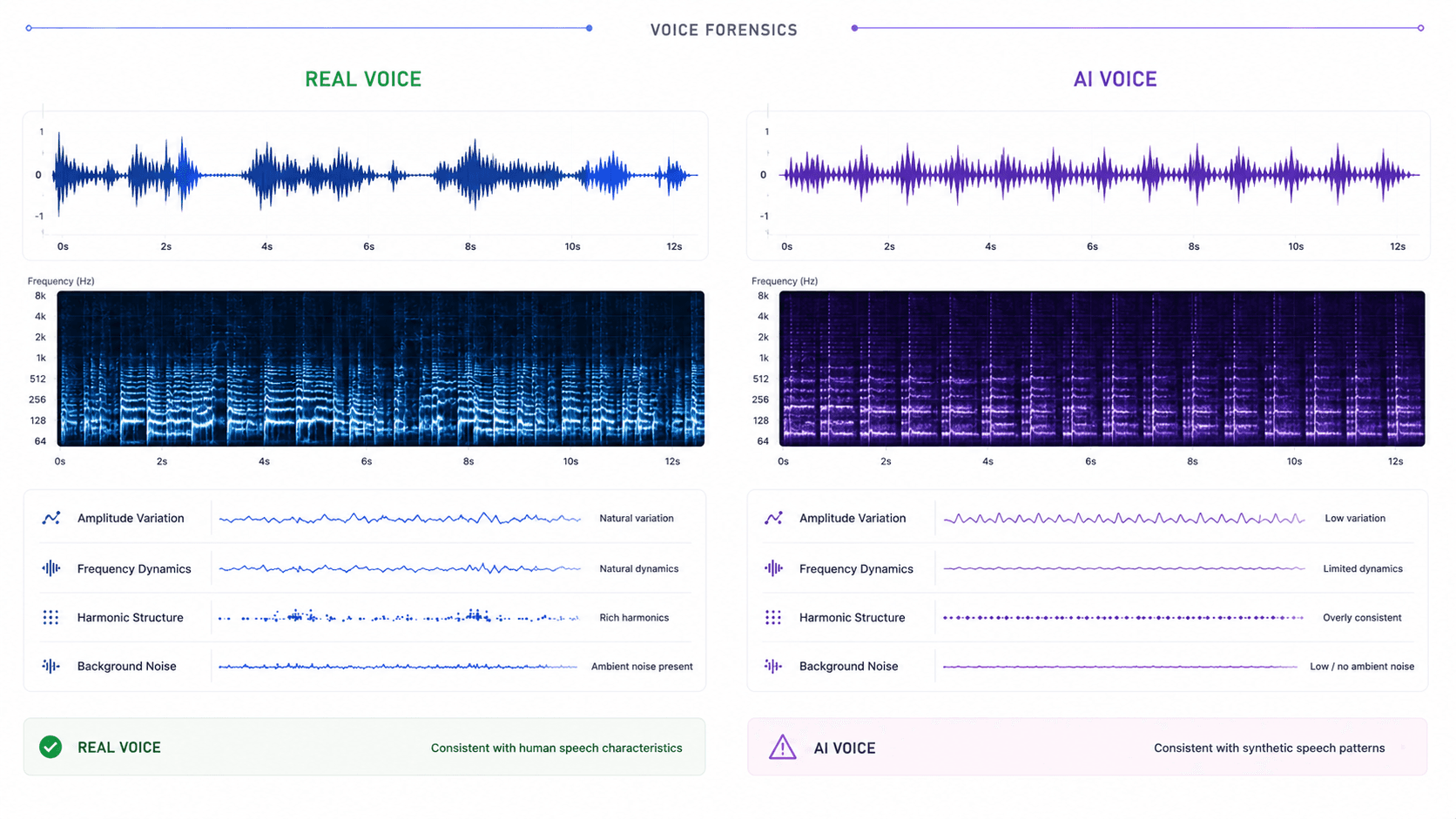
Investigators may need to review hours or even days of audio to find a few minutes of relevant conversation. Recordings can also contain background noise, overlapping speakers, poor telephone quality and long periods of silence. It helps investigators find, isolate and organise a specific person's voice across long recordings, intercepted calls and other complex audio evidence.
VoiceExtract AI uses a known voice sample to search large audio collections for likely occurrences of the same speaker. Relevant speech is then isolated, cleaned and organised with timestamps, so analysts spend less time listening through unrelated material.
VoiceExtract AI also supports speaker comparison during the same workflow. For cases that require greater caution, enhanced verification applies stricter acceptance checks designed to reduce the likelihood of unrelated voices being included.
Controlled environment
Run sensitive forensic audio analysis within approved infrastructure
Speaker intelligence
Compare speech against authorised reference profiles to locate the target
Clearer evidence
Work with recordings carrying background noise, poor call quality or competing voices
Secure by design
Keep evidence, case information and voice profiles protected throughout
High-level architecture
Upload supported evidence and let the platform check noise, clarity and recording conditions before analysis begins.
Provide authorised samples of the target speaker; clearer source material carries greater weight in the reference profile.
Examine long recordings for portions that may contain the target speaker, then analyse promising sections more closely.
Check potential matches against the authorised reference, with enhanced verification where a case needs more conservative matching.
Group accepted segments into chronological sessions and prepare an evidence package of audio, timestamps and reporting material.
Interface simulation: an illustration of the workflow, not a live analysis
Upload supported evidence and let the platform check noise, clarity and recording conditions before analysis begins.
Provide authorised samples of the target speaker; clearer source material carries greater weight in the reference profile.
Examine long recordings for portions that may contain the target speaker, then analyse promising sections more closely.
Check potential matches against the authorised reference, with enhanced verification where a case needs more conservative matching.
Group accepted segments into chronological sessions and prepare an evidence package of audio, timestamps and reporting material.
Product exclusiveness
Advanced Voice Identity Analysis
Interface simulation: an illustration of the workflow, not a live analysis
Market comparison
Large audio review
Target speaker extraction
False-match management
Noisy recording support
Private deployment
Multiple reference samples
Changing recording conditions
Conversation organisation
Evidence documentation
Batch investigation workflow
The architecture
PROTECTED EVIDENCE STORAGE · SECURED INTERNAL COMMUNICATION · LOCAL ANALYSIS RESOURCES
Sector use cases
Search large collections of intercepted or surveillance audio for speech associated with a person of interest, and bring relevant conversations together chronologically for case review.
Analyse authorised radio, communication and field recordings in controlled environments, keeping sensitive material inside approved infrastructure.
Prepare complex audio for specialist review by organising relevant speech, timestamps and case information into a structured evidence package.
Review authorised call recordings for voices linked to known fraud investigations, impersonation attempts or organised financial crime.
Review authorised call recordings to help identify potential involvement of monitored or restricted parties, in line with institutional policy and applicable law.
Support authorised investigations involving difficult field recordings, communication intercepts and other low-quality audio sources.
Deployment strategy
Requirements depend on expected recording volumes, workload and deployment model. VoiceExtract AI can be configured from dedicated investigation workstations up to larger controlled server environments, and a technical assessment determines the appropriate configuration.
Sized to the evidence volume it will carry
Deploy inside approved infrastructure, including isolated environments where evidence processing must remain within the organisation's own network. Voice analysis can run without routine communication with external AI services.
Suited to strict data-residency requirements
Authorised organisations maintain a controlled library of speaker profiles, approved case references and voice samples, then use those profiles across permitted investigations without preparing every comparison individually.
Approved profiles, reused across permitted cases
Standard verification supports efficient investigative review across larger collections of audio. Enhanced verification applies more conservative acceptance checks where an investigation requires additional scrutiny of potential voice matches.
Scrutiny set by what the investigation needs
Relevant speech segments, chronological session information, timestamps, case references and supporting reports are exported in formats aligned to the organisation's investigation, evidence management and archival requirements.
A package the evidence process already accepts
Audio evidence, authorised voice profiles and associated case information can be stored within protected organisational infrastructure, and temporary processing material is managed and cleared as part of the analysis lifecycle.
Security, compliance & data architecture
Frequently asked questions
It can work from a short, clear sample of the target speaker. Where available, additional high-quality reference speech helps create a stronger voice profile: the quality of the reference matters more than the amount of audio provided.
Yes. Potential segments are compared with an authorised target voice profile before they are included as relevant results, so investigators can search for the target speaker and evaluate voice consistency within the same workflow.
Yes. It is designed for multi-speaker recordings such as intercepted calls, meetings and surveillance audio. Where authorised speaker profiles are available, it can associate relevant speech with those profiles and organise results into clearer speaker timelines.
Audio enhancement and noise-aware analysis reduce distracting background sound while preserving the speech information needed for later analysis, and recording quality is considered when evaluating potential matches. Results from severely degraded recordings should always be reviewed alongside the wider investigation evidence.
Yes. It can be deployed in controlled or isolated environments where evidence processing must remain within the organisation's own infrastructure, suiting agencies that restrict external network access for sensitive systems.
Requirements depend on expected recording volumes, workload and deployment model. VoiceExtract AI can be configured from dedicated investigation workstations up to larger controlled server environments; a technical assessment determines the appropriate configuration.
Standard verification is intended for efficient investigative review across larger collections of audio. Enhanced verification applies more conservative acceptance checks when an investigation requires additional scrutiny of potential voice matches.
The platform examines the timing and continuity of relevant speech and automatically groups related segments into chronological sessions, making long recordings easier to navigate and showing when target conversations occurred.
It can include organised audio segments, chronological session information, timestamps, case references and supporting reports, with export formats aligned to the organisation's investigation, evidence management and archival requirements.
The rest of the line
Where it runs
Each sector page covers the threat model, the controls, and the regulators that apply.
Connect with a FaceOff AI Forensic Specialist to evaluate VoiceExtract AI within your organisation's own environment.