
Skip to content
FaceOff Technologies

CallScreener AI

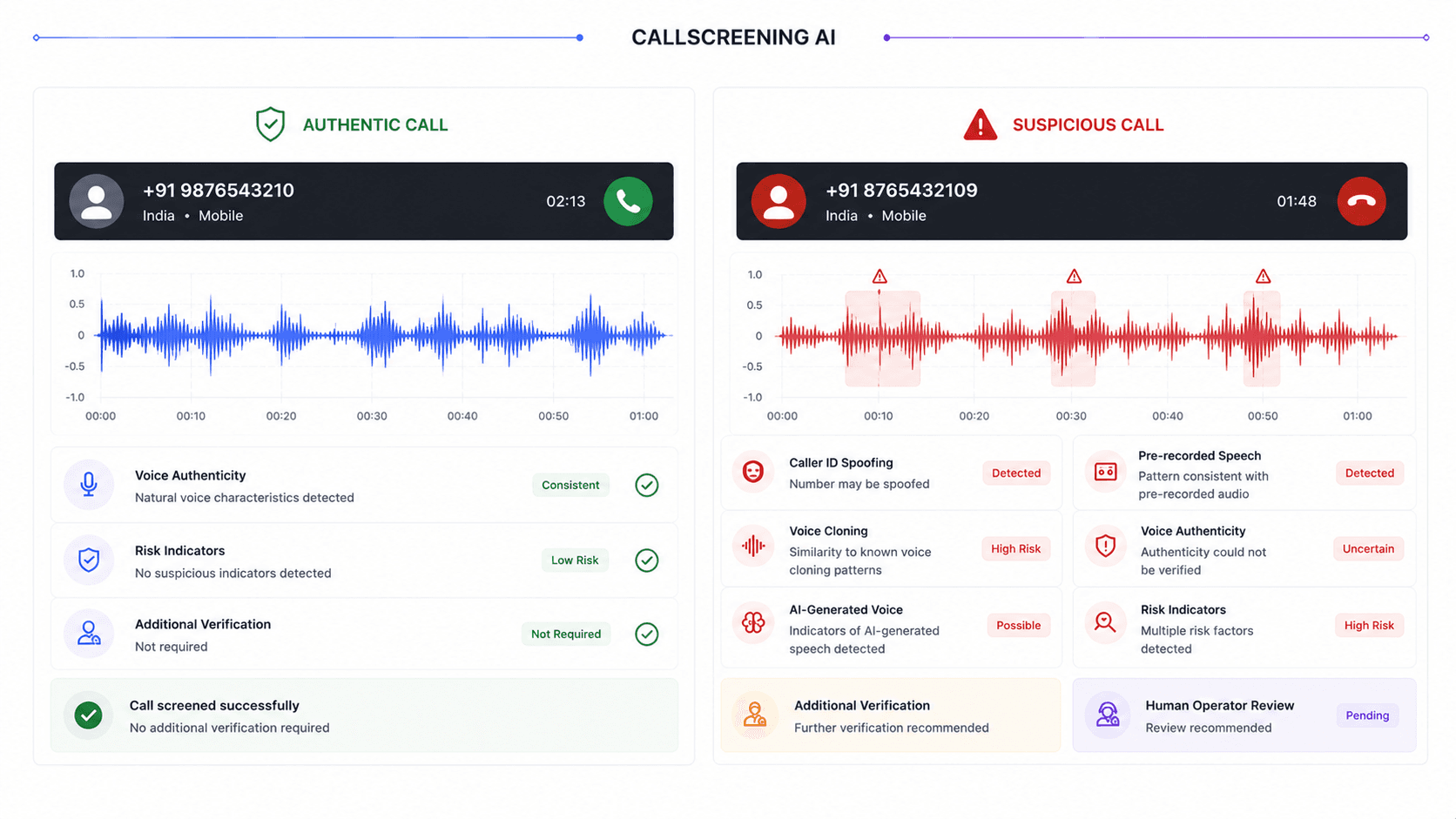
CallScreener AI screens incoming calls in real time to help identify suspicious callers, voice impersonation, robocalls and AI generated voices before they reach your team. It combines conversation screening, caller verification and voice authenticity analysis, while keeping sensitive call data within approved environments.

CallScreener AI · workspaceCall received
Incoming callerConversation contextLive speech
call in progressno markings
  1. Received
  2. Screening
  3. Voice
  4. Context
  5. Handover

What is assessed

  • Caller screeningwaiting
  • Authenticitywaiting
  • Call contextwaiting
Running

Interface simulation: an illustration of the workflow, not a live analysis

CallScreener AI

Who Is Really Calling?

Follow a call while it is still happening

01INCOMING
02SCREENING
03RECORD

CallScreener AI

Screen the call, keep the record

Real-time voice screening for cloned voices and fraudulent callers

Explore CallScreener AI

What it is

Real time AI call screening and voice deepfake detection

CallScreener AI

Phone based fraud is becoming harder to recognise as attackers use caller ID spoofing, prerecorded speech, voice cloning and AI generated voices to impersonate trusted people. CallScreener AI adds an intelligent screening layer before incoming calls reach employees, customer service teams or sensitive business processes.

The platform can engage callers, understand why they are calling, examine voice authenticity and provide relevant risk indicators. Suspicious or uncertain calls can receive additional verification or be transferred to a human operator for review.

CallScreener AI is designed to support human and policy based decisions, rather than treating a single voice or behavioural signal as proof of fraud.

Process sensitive call information within approved organisational infrastructure

Private deployment

Process sensitive call information within approved organisational infrastructure

Identify potential indicators of synthetic, manipulated or replayed voices

Voice authenticity

Identify potential indicators of synthetic, manipulated or replayed voices

Understand caller intent before a call reaches an employee

Intelligent screening

Understand caller intent before a call reaches an employee

Keep recordings, transcripts and related information under organisational control

Protected call data

Keep recordings, transcripts and related information under organisational control

High level architecture

From incoming call to informed action

  1. 01

    Receive the call

    An incoming call enters the organisation's approved screening workflow, without requiring the employee to answer first.

    Caller screeningAuthenticityCall contextCALL RECEIVEDASSESSED WHILE THE CALL RUNSAUTHENTICITYAdditional verification requiredView evidence →Report previewTRANSCRIPTThe screening conversation, and what followed itTIMELINEHow the call developedOBSERVATIONSThe screening information behind the outcome
  2. 02

    Screen the caller

    A voice assistant interacts naturally with the caller to understand the reason for the call and collect appropriate verification information.

    Caller screeningAuthenticityCall contextCALLER SCREENEDASSESSED WHILE THE CALL RUNSAUTHENTICITYAdditional verification requiredView evidence →Report previewTRANSCRIPTThe screening conversation, and what followed itTIMELINEHow the call developedOBSERVATIONSThe screening information behind the outcome
  3. 03

    Assess voice authenticity

    The live conversation is examined for indicators that may suggest AI generated, manipulated or replayed speech.

    Caller screeningAuthenticityCall contextVOICE AUTHENTICITY ASSESSEDASSESSED WHILE THE CALL RUNSAUTHENTICITYAdditional verification requiredView evidence →Report previewTRANSCRIPTThe screening conversation, and what followed itTIMELINEHow the call developedOBSERVATIONSThe screening information behind the outcome
  4. 04

    Build conversation context

    Relevant observations are organised into a clear timeline for authorised reviewers.

    Caller screeningAuthenticityCall contextCONVERSATION TIMELINE BUILTASSESSED WHILE THE CALL RUNSAUTHENTICITYAdditional verification requiredView evidence →Report previewTRANSCRIPTThe screening conversation, and what followed itTIMELINEHow the call developedOBSERVATIONSThe screening information behind the outcome
  5. 05

    Decide and hand over

    Calls proceed, receive additional verification or transfer to an authorised agent, according to organisational policy.

    Caller screeningAuthenticityCall contextDECISION AND HANDOVERASSESSED WHILE THE CALL RUNSAUTHENTICITYAdditional verification requiredView evidence →Report previewTRANSCRIPTThe screening conversation, and what followed itTIMELINEHow the call developedOBSERVATIONSThe screening information behind the outcome

Product exclusiveness

Seven flagship capabilities

Continuous voice authenticity screening

THROUGHOUT THE CONVERSATIONCall receivedCaller screenedVoice assessedContext builtCaller ID alone cannot establish that the person speaking is genuine

Interface simulation: an illustration of the workflow, not a live analysis

Market comparison

How CallScreener AI compares with traditional call security

CallScreener AI combines AI call screening, voice deepfake detection, caller verification and investigation support within one controlled workflow.

  • Caller screening

    Traditional IVR
    Partly: Menu based interaction
    Caller ID and spam filtering
    Partly: Primarily number reputation
    CallScreener AI
    Yes: Intelligent conversational screening
  • Voice authenticity analysis

    Traditional IVR
    No: Not typically available
    Caller ID and spam filtering
    No: Not typically available
    CallScreener AI
    Yes: Potential synthetic or manipulated voice
  • Protection from prerecorded responses

    Traditional IVR
    No: Limited
    Caller ID and spam filtering
    No: Limited
    CallScreener AI
    Yes: Dynamic conversational verification
  • AI voice deepfake detection

    Traditional IVR
    No: Not typically available
    Caller ID and spam filtering
    No: Not typically available
    CallScreener AI
    Yes: Integrated into the screening workflow
  • Automated call screening

    Traditional IVR
    Partly: Basic routing
    Caller ID and spam filtering
    No: Usually unavailable
    CallScreener AI
    Yes: Intelligent first line screening
  • Human agent handoff

    Traditional IVR
    Partly: Standard transfer
    Caller ID and spam filtering
    No: Not applicable
    CallScreener AI
    Yes: Transfer with relevant screening context
  • Conversation insights

    Traditional IVR
    No: Limited
    Caller ID and spam filtering
    No: Not available
    CallScreener AI
    Yes: Contextual call timeline and review
  • Investigation support

    Traditional IVR
    No: Usually manual
    Caller ID and spam filtering
    No: Limited call information
    CallScreener AI
    Yes: AI assisted authorised call review
  • Private deployment

    Traditional IVR
    Partly: Depends on environment
    Caller ID and spam filtering
    No: Often service dependent
    CallScreener AI
    Yes: Supports controlled deployment
  • Structured reports

    Traditional IVR
    No: Usually separate
    Caller ID and spam filtering
    No: Limited
    CallScreener AI
    Yes: Integrated reporting and transcripts

The architecture

Hosted within your environment for greater data control

Call recordings, transcripts and analysis results can remain within approved organisational infrastructure

APPROVED ORGANISATIONAL ENVIRONMENTCALL RECORDINGS · TRANSCRIPTS · ANALYSIS RESULTS
Layer 1

Data sovereignty

  • Call data stays in placeRecordings, transcripts and analysis results remain in the approved environment
  • Governed by your policyHeld according to the organisation's security and data governance requirements
Held where you decide
Layer 2

Protected information

  • Protected in storageSensitive call data held under organisational security controls
  • Protected in processingThe same controls apply while a call is being screened and analysed
Protected in use
Layer 3

Controlled connectivity

  • Restricted communicationThe organisation decides how voice analysis services reach other systems
  • Defined data movementWhere sensitive call information travels through the deployment is set locally
Connectivity controlled
Layer 4

Future ready security

  • Evolving requirementsThe deployment supports organisational policies as they change
  • Changing standardsProtection can adapt as security and protection standards develop

PRIVATE DEPLOYMENT · CONTROLLED DATA · SECURE CALL INTELLIGENCE

Sector use cases

Where CallScreener AI applies

Banking and financial services

Help protect phone banking interactions, high value transaction requests and customer service workflows from voice impersonation and AI enabled social engineering, with additional verification before sensitive actions proceed.

Insurance and claims

Screen authorised claims related calls for potential voice impersonation, prerecorded responses or unusual call characteristics, helping investigators identify conversations that need further review.

Telecommunications

Add stronger verification to sensitive customer requests such as account changes and number transfers, alongside existing identity checks.

Enterprise support and helpdesks

Help protect employees from callers impersonating executives, colleagues, customers or trusted partners, particularly on requests involving credentials, account access or financial information.

Government and public services

Screen authorised calls to public service lines for potential impersonation, automated abuse or manipulated voice, with deployment inside approved infrastructure where call information requires stricter control.

Regulated customer verification

Support authorised voice and video assisted verification workflows with call screening, voice authenticity analysis and human oversight. It complements existing identity and compliance procedures rather than guaranteeing regulatory compliance.

Deployment strategy

From telephony integration to reviewed calls

  1. Integrate with the telephony environment

    CallScreener AI is designed to integrate with modern enterprise telephony, contact centre and call management environments. The exact approach depends on the organisation's existing infrastructure and deployment requirements.

    Works with the call platform already in place

  2. Deploy within approved infrastructure

    Call recordings, transcripts and related analysis information can remain within the organisation's approved infrastructure, with the organisation defining how authorised services communicate and where sensitive call information is processed.

    Sensitive call data stays under organisational control

  3. Configure screening and verification

    Conversational questions and verification requests are configured around approved organisational procedures, so the automated first line follows the rules the organisation already applies to sensitive calls.

    Screening that follows existing procedure

  4. Set the handoff rules

    Routine calls follow the approved automated workflow, while suspicious or uncertain interactions transfer to an authorised agent with the relevant screening context already available.

    Automated first line, human judgement where it matters

  5. Review and retain

    Screening conversations and subsequent agent interactions are organised into transcripts and structured reports, with storage, access and retention aligned to the organisation's privacy, security and governance requirements.

    Review ready records, retained on your terms

Deployment that fits your telephony environment

Whether CallScreener AI is evaluated on a single line or introduced across a contact centre, the integration approach depends on the organisation's existing infrastructure, and call recordings, transcripts and related information can remain within its approved environment throughout.

Security, compliance and data architecture

Voice verification with organisational control

CallScreener AI is designed for environments where voice recordings, transcripts and caller information require careful protection.

Data sovereignty
Call recordings, transcripts and related analysis information can remain within your organisation's approved infrastructure.
Protected storage
Sensitive information can be protected according to organisational security, access control and retention policies.
Future ready protection
The platform can support evolving security approaches without exposing sensitive implementation details.
Controlled processing
Organisations can define how authorised services communicate and where sensitive call information is processed.

Frequently asked questions

CallScreener AI, answered

It examines live speech for patterns that may indicate synthetic, manipulated or replayed audio. Those findings are considered alongside the wider screening interaction, without exposing the underlying detection methods.

Book a CallScreener AI walkthrough

See call screening, caller verification and voice authenticity analysis with our team.

We use this to schedule the call. It does not enter a marketing sequence.

The rest of the line

More in Voice Forensics

Screen every call before it becomes a risk

See how CallScreener AI screens callers, checks voice authenticity and hands difficult calls to your team.