
News · Newsroom · 3 days ago
NVIDIA’s Hugging Face Deal Could Reshape Open AI
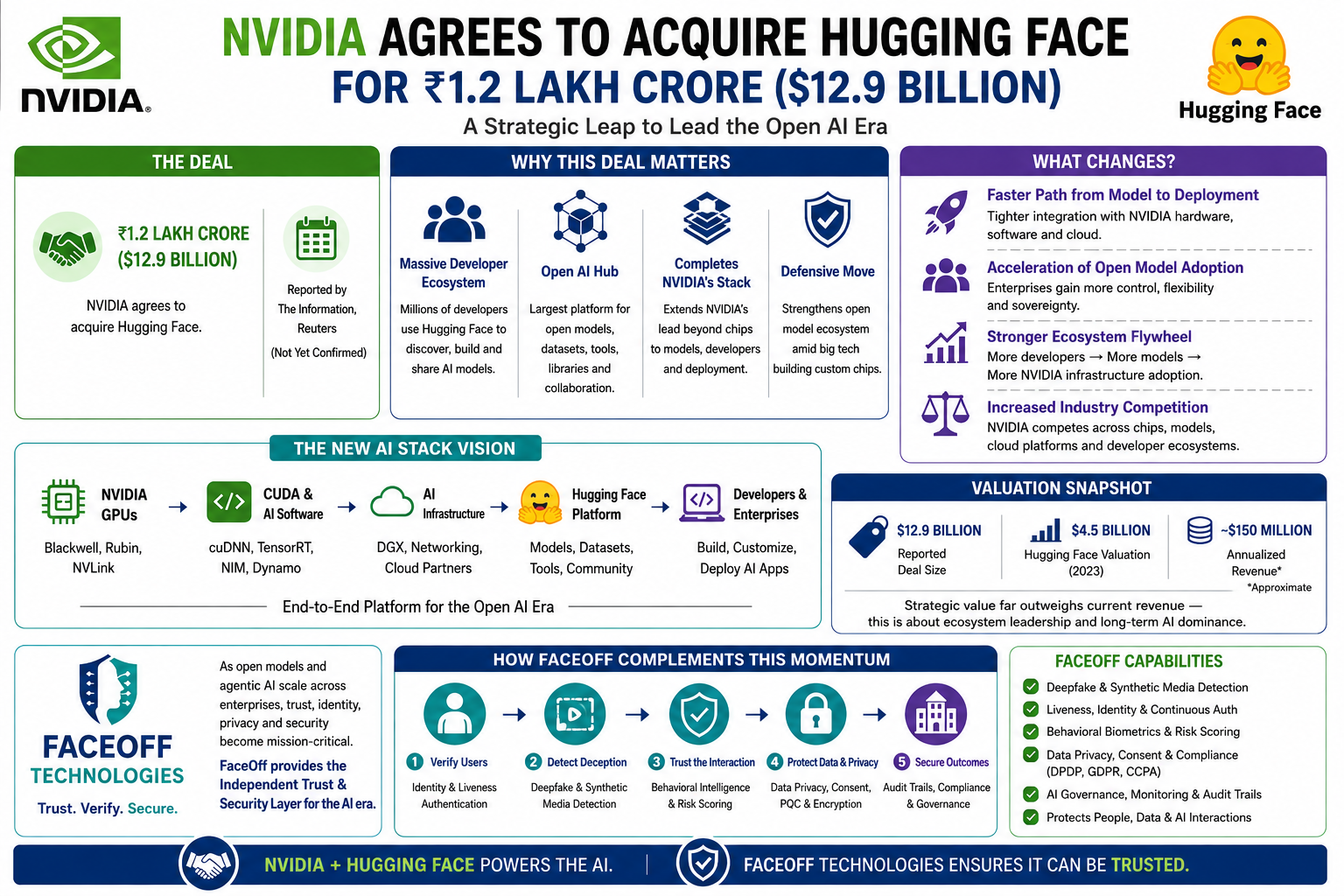
NVIDIA has reportedly agreed to acquire Hugging Face for $12.9 billion in what could become one of NVIDIA’s largest acquisitions. The Information first reported the agreement, while Reuters noted that NVIDIA and Hugging Face had not yet publicly confirmed the transaction.
The deal is strategically far more important than simply buying another AI startup. Hugging Face has become a central marketplace and collaboration platform for open AI, where developers discover, share, optimize and deploy models and datasets. NVIDIA already dominates the GPU infrastructure used to train and run AI; ownership of Hugging Face could extend its influence much further into the model, developer and deployment layers.
From GPUs to the Complete AI Stack
NVIDIA's traditional strength has been accelerated computing. But the company has steadily expanded into networking, AI software, inference, models, cloud infrastructure, robotics and agentic AI.
Hugging Face could provide an important missing link: direct access to a massive ecosystem of developers and open models.
The potential stack could significantly shorten the journey from downloading an open model to optimizing and deploying it on NVIDIA infrastructure.
NVIDIA has already demonstrated this strategy through its Nemotron family. Its open models are distributed through Hugging Face and can be deployed using NVIDIA technologies including NIM, TensorRT LLM and Dynamo.
What Changes for the Industry?
The first change could be tighter integration between models and NVIDIA hardware. Developers may gain easier access to optimized inference, training, fine-tuning and deployment.
Second, enterprise adoption of open models could accelerate. Organizations concerned about sending sensitive information to closed AI services increasingly want models they can deploy privately, customize and control.
Third, competition could intensify across the entire AI stack. NVIDIA would increasingly compete not only with AMD and custom accelerators at the silicon layer, but indirectly with cloud providers and closed AI ecosystems at the platform level.
There is, however, an important concern: neutrality. Hugging Face historically supports a broad hardware and software ecosystem. If the acquisition closes, developers and competitors will closely watch whether the platform remains equally welcoming to AMD, Intel, Google and other hardware architectures.
The reported valuation itself demonstrates how strategically valuable the platform has become. Hugging Face was valued at $4.5 billion in 2023, while its recent annualized revenue was reportedly around $150 million. NVIDIA would therefore be paying primarily for ecosystem position and future strategic value, rather than current revenue.
FaceOff Can Complement the Momentum
This development also creates an interesting opportunity for FaceOff Technologies.
As open models become easier to download, customize and deploy, enterprises will need an independent trust and security layer around those models and the agents built from them.
FaceOff's multimodal capabilities could address deepfake and synthetic-media detection, liveness, behavioral intelligence, identity trust and risk scoring, while its privacy and security stack can help organizations govern sensitive information used by AI applications.
This becomes particularly important for autonomous agents. The question will no longer be simply, “Which model is best?” Enterprises will increasingly ask: Who is interacting with the model? Is the input authentic? What data can the agent access? Can its actions be trusted? And can the transaction be independently verified?
The strategic positioning for FaceOff could therefore be:
“NVIDIA + Hugging Face powers the AI. FaceOff establishes whether the human, content, data and AI interaction can be trusted.”
That could position FaceOff as a complementary AI Trust, Privacy and Security Layer for enterprises deploying increasingly powerful open-source and agentic AI systems.